
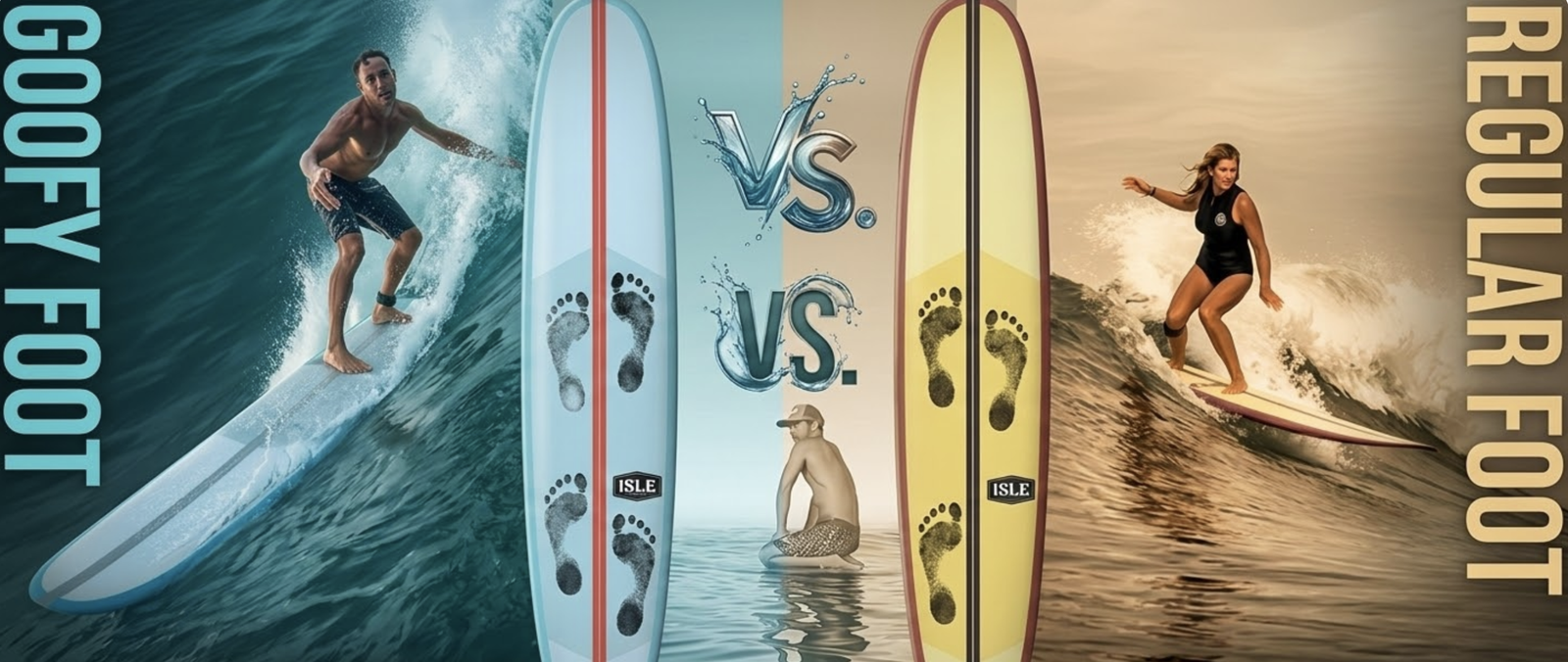
Every surfer falls into one of two categories: regular foot surfer and goofy foot surfer. You may have heard of goofy and regular. These are frequent terms in surfing and skating, windsurfing, snowboarding, and wakeboarding.
Before you start learning how to surf, you need to figure out your surfing stance. This determines which foot is in front of the other when you stand up on your surfboard. There is no right or wrong stance – it all boils down to what makes you comfortable when you try to balance.
Goofy foot surfing always intrigued beginners, primarily because of what it is called. This article is all about what goofy foot surfing is and everything you need to know about this stance.
Table of Contents
What Is Goofy Foot Surfing?
Goofy foot surfing or goofy footed surfers refers to the stance where the surfer places his right foot forward and left foot back. A goofy foot surfer is less common than a regular foot surfer, in the same way, there are more right-handed people than left-handed.
The goofy foot is one of the oldest terms in surfing that is still widely used as surfing jargon.
But, where does the term “goofy” come from?
Theory One: Disney’s “Hawaiian Holiday”
Theory one relates it to Walt Disney’s 1937 animated film “Hawaiian Holiday.” The film featured Mickey Mouse, Minnie Mouse, Pluto, Goofy, Donald Duck, a crab, and a starfish. Goofy was in his surfing sessions, and he showed a right-foot forward stance before falling off into a horrendous wipeout.
The hitch was – in the movie, Goofy also rides regularly with his left foot forward. Moreover, the term “goofy” originally coined from the word “goff” was by then a derogatory word meaning “fool,” “weird,” or “silly.”
Perhaps, it was why Disney named his character “Goofy,” being a clumsy anthropomorphic dog.
Theory Two: Desmond Muirhead’s “Surfing in Hawaii”
Muirhead was an internationally renowned golf course designer. A former Hawaii resident around the 1960s, he was a frequent visitor in the following years and was described by different golf publications as the most innovative golf course architect.
One of his projects was the five golf courses he designed in partnership with Jack Nicklaus. His controversial designs proved hypocritical criticisms from the world of golf and golf architecture.
His visits back to Hawaii led him to fall in love with surfing. He took lessons and later on became a well-rounded surfer. After his first contact with Waikiki’s perfect waves, he felt like writing a book, so he published one entitled “Surfing in Hawaii.”
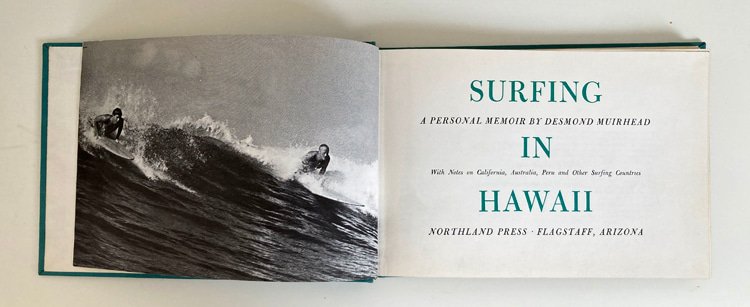
In his book, the first-ever written reference to “goofy-footed surfers” can be read. In Chapter V, “The Beginner and the Philosophy of Surfing.”, page 51, it said;
“People who put their right foot forward are called ‘goofy foots.’ Personally, I find this position the most comfortable.”
Muirhead’s daughter brought the book back to life when it was republished on SurferToday.com.
Looking at the timeline, Muirhead only started surfing around 1956. His book was published in 1962. This sequence makes it plausible that the expression “goofy-footed” has been in use before 1962.
How To Find Out What Stance You Are?
The simplest way to determine whether you are a regular-footed surfer or a goofy-footed surfer is to identify your dominant foot.
- The “Push Test”: Stand still and have someone gently push you from behind. Whichever foot you instinctively step forward with is likely your leading foot on a surfboard.
- Skateboard Test: Try riding a skateboard. The foot you place forward while skating will generally be the same when surfing.
- Comfort and Natural Movement: Above all, your surfing stance should feel natural and comfortable. If Goofy Foot feels right, then it’s your stance.
Again:
- Left foot forward = regular foot surfing
- Right foot forward = goofy foot surfing
Most right-handed people have their right foot as their dominant foot, too. The same goes with most left-handed people who have left as their dominant foot, as well. This is why most right-handed people have a regular foot-surfing stance, while most left-handed have a goofy foot-surfing stance.
However, this won’t always be the case. As with most sporting activities, it may also rely on how comfortable you are. Some right-handed people prefer goofy foot surfing, and some left-handed prefer regular.
Learning to Surf as a Goofy Footer
Starting your surfing journey as a Goofy Footer can be a unique experience. While most surf instructors teach Regular Foot first, it’s important to stick with what feels right for you.
- Beginner Tips: Focus on your balance and foot placement early on. Practicing pop-ups (the motion of standing up on your board) can help you get comfortable with your Goofy Foot stance.
- Common Challenges: You may find certain waves or maneuvers more challenging due to the stance. However, with practice and persistence, these obstacles can be overcome.
- Adapting to Waves: Different waves may require slight adjustments in your stance and approach. Learning to read the waves and how they break will help you adapt your surfing style.
Frontside and Backside Surfing
Now that we are clear with the surfing stance, we need to understand the subsequent terms closely related to goofy foot and regular foot surfing – frontside and backside. These two terms relate to the direction your body faces when you ride a wave.
Frontside
This is when a surfer’s chest and toes are facing the wave. Most regular-footed surfers ride frontside on the waves that are breaking to their right. On the other hand, they ride backside on waves that are breaking to their left.
Backside
This is when a surfer’s back and heels are facing the wave. Most goofy foot surfers ride frontside on waves that are breaking to their left. They ride backside on waves that are breaking to their right.
By and large, most surfers prefer surfing frontside to backside since it makes the ride feel more natural, especially when going down the line. As a result, learning how to surf the back side will be more difficult at first.
But, once you progress as a surfer and understand how to shred waves frontside and backside, you might not prefer one over the other. You might even start favoring surfing the backside over the front side.
Ideal Surf Breaks for Regular and Goofy Foot Surfing
Given that most surfers prefer surfing frontside, regular and goofy foot surfers tend to choose surf breaks that present the best waves for their stance. First, understand the difference between a beach break and a point break.
Beach breaks are those where waves break over a sandy bottom, while point breaks are waves that form off a point and break along a stretch of land.
Point breaks are categorized as either a right-hand point break or a left-hand point break. A right-hand point break means waves point mainly to the right. A left-hand point breaks left accordingly. This is why regular foot surfers love surfing at right-hand point breaks, and goofy foot surfers love surfing at left-hand point breaks.
For regular foot surfing, the best surf break is a right-hand point break. On the contrary, goofy foot surfing’s ideal surf break is a left-hand point break. These allow both regular and goofy-footed to exclusively surf frontside on every wave.
Point breaks are perfect spots for you to learn how to surf no matter which surfing stance you ride. However, keep in mind that most of the popular point breaks tend to have a localized circle, so remember to be courteous and follow the proper surf etiquette when you are up in the lineup.
Beach breaks don’t come short for both surfing regular and goofy foot stances, too. Generally, the mood and impression at beach breaks are a lot more welcoming and will give you the option to surf frontside or backside.
How Goofy Foot Affects Surfing Techniques
Your surfing stance can have a notable impact on how you execute various techniques on the waves.
- Turns and Cutbacks: Goofy Foot surfers might find certain turns easier, especially on left-breaking waves where their stance naturally aligns with the wave’s direction.
- Wave Approach: The way you approach a wave can differ depending on whether you’re Goofy Foot or Regular Foot. Goofy Footers often have a unique approach that stands out in competitions.
- Adjusting Style: As you progress, you’ll learn to adjust your style to suit your stance, making the most of your Goofy Foot orientation.
Goofy Foot Surfing Gear
Choosing the right gear is crucial for any surfer, but Goofy Footers should pay special attention to a few aspects.
- Surfboard Selection: While the board shape is the same for both stances, make sure the size and design suit your surfing style and the waves you frequent.
- Fins and Setup: Fins play a key role in maneuverability. Experiment with different fin setups to find what works best for your Goofy Foot stance.
- Wetsuits and Accessories: Comfort is key. Ensure your wetsuit fits well and doesn’t restrict movement, particularly in your legs and feet.
Training and Drills for Goofy Footers
To excel as a Goofy Footer, incorporating specific training and drills into your routine can make a big difference.
- Balance Exercises: Work on your core stability and balance through exercises like yoga, balance boards, and leg strength training.
- Skateboarding: Many surfers use skateboarding to cross-train. Riding a skateboard in a Goofy Foot stance can help you practice foot placement, turns, and overall balance, which directly translates to better surfing.
- Foot Positioning Drills: Practice your pop-up and stance on land using a surfboard or balance board. Consistently refining your foot positioning will help you feel more natural and confident on the waves.
Challenges Faced by Goofy Footers
While Goofy Foot surfing is entirely valid and can be advantageous, there are some challenges that Goofy Foot surfers may encounter.
- Navigating Regular Foot Waves: Many surf spots have waves that predominantly favor Regular Foot surfers, especially those that break to the right. Goofy Footers may need to adjust their technique to ride these waves effectively.
- Finding Instructors: Although most surf instructors are proficient in teaching both stances, some may have a bias toward Regular Foot techniques. As a Goofy Footer, you might need to be more proactive in seeking guidance that aligns with your stance.
- Societal Perceptions: In some surfing communities, Goofy Foot surfing may be viewed as less common or unconventional. While this is just a perception and has no bearing on skill or ability, it’s something some Goofy Footers might experience.
The Best Goofy Footers of All Time

Adrian Buchan Barton Lynch
Bobby Martinez Christian Fletcher
CJ Hobgood Clay Marzo
Damien Hardman Damien Hobgood
Derek Ho Gabriel Medina
Gary Green Gerry LopezGlen Winton
Jim Blears Joel Tudor
Kalani Robb Luke Egan
Mark Occhilupo Nathan Fletcher
Rob Machado Robert August
Rolf Aurness Tim Curran
Tom Carroll Wayne Lynch
Conclusion
Goofy Foot surfing is more than just a quirky term—it’s a legitimate and respected stance in the world of surfing. Whether you’re naturally inclined towards Goofy Foot or Regular Foot, the most important thing is to embrace your stance and use it to your advantage. By understanding your stance, practicing the right techniques, and choosing the appropriate gear, you can make the most of your time on the waves.
Surfing is a personal journey, and whether you’re a Goofy Footer or not, the ultimate goal is to find joy and freedom in riding the waves. So get out there, embrace your natural stance, and surf with confidence!
FAQs (Frequently Asked Questions)
Q: What is the difference between regular and goofy foot surfers?
A: The difference between the two boils down to how comfortably the rider prefers their feet positioned on the surfboard as they ride a wave.
Q: What percentage of surfers are Goofy Foot?
A: Approximately 30-40% of surfers are Goofy Foot, making it less common than the Regular Foot stance, which is favored by about 60-70% of surfers.
Q: Is Goofy Foot surfing harder than Regular Foot?
A: No, Goofy Foot surfing is not inherently harder. The difficulty is subjective and depends on what feels more natural for the individual surfer.
Q: Can you switch between Goofy Foot and Regular Foot?
Yes, it is possible to switch between stances, though it may require practice and adjustment. Some surfers are ambidextrous in their stance and can ride comfortably in both.
Q: How do I know if I should surf Goofy Foot or Regular Foot?
A: Your natural stance will usually feel more comfortable. Testing your stance with activities like skateboarding or the “push test” can help you determine whether Goofy Foot or Regular Foot is right for you.
Related Resources
- How Does a Surfing Lineup Work?
- Best Workouts for Surfing
- Best Surfers of All Time
- Famous Female Surfers of All Time
- Best Places to Surf Without Sharks

Luke Morris is an avid athlete and the driving force behind Surfhungry, a vibrant online platform dedicated to sharing the joy and passion of surfing and water sports with enthusiasts around the world. With a deep-rooted love for the ocean and a lifelong commitment to riding waves, Luke’s journey as a surfer has inspired him to create a community where like-minded individuals can come together to celebrate their shared passion.