How Surf Travelers Can Create a Quick, Efficient Packing System

Efficient Packing System for Surf Travelers

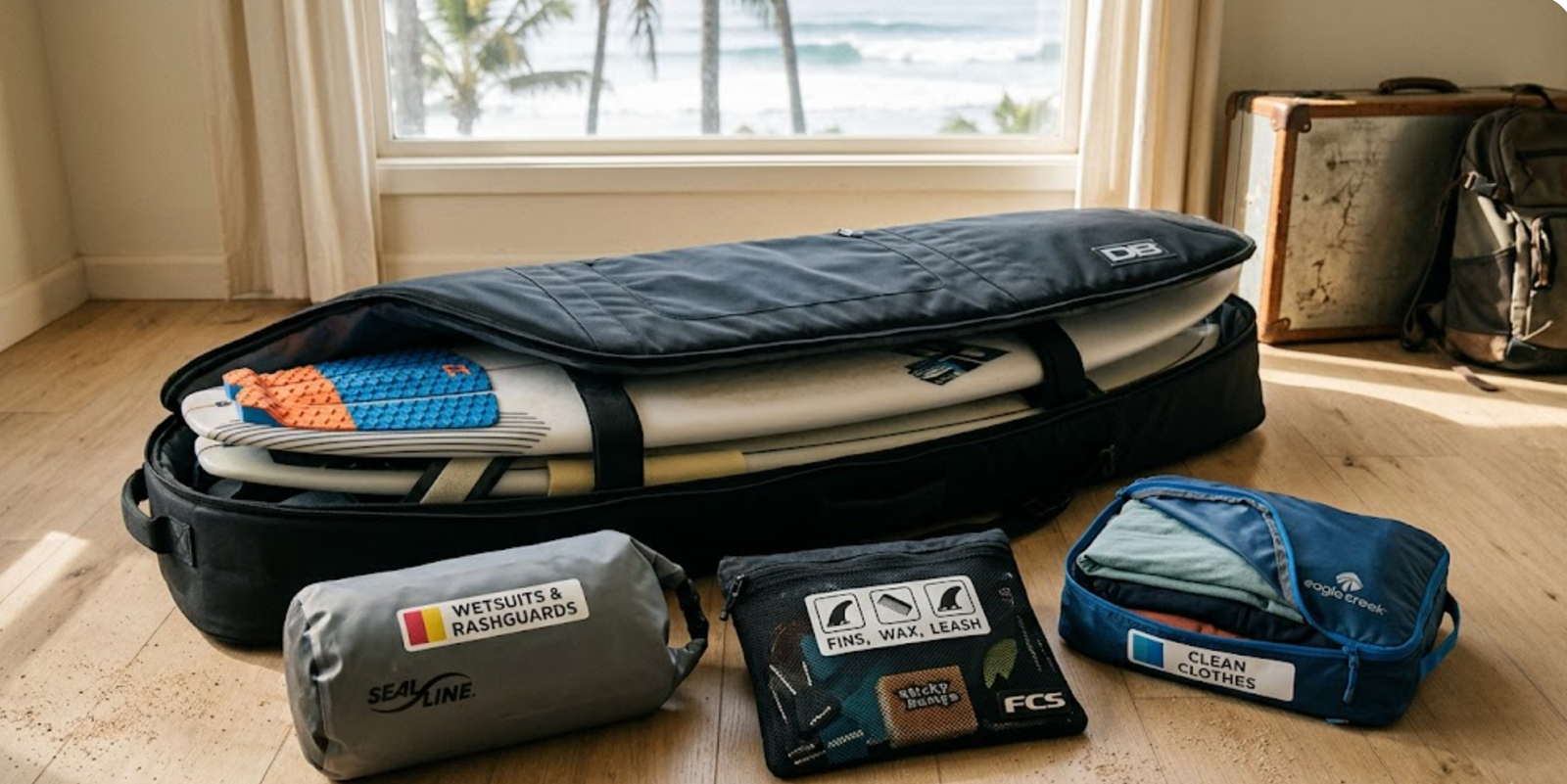
https://surfhungry.com/top-surfing-destinations-map/Surf travelers face a specific kind of chaos. Traveling with surfboards, wetsuits, leashes, fins, wax, and sun-faded towels is not the same as packing for a weekend city trip. Surf travel is gear-heavy, moisture-prone, and often rushed — especially when you’re moving between airports, rental cars, boats, and beachside accommodations. An efficient packing system for surf travel isn’t about cramming more into a bag. It’s about designing a repeatable setup that protects your boards, separates wet from dry, and lets you move quickly without losing small but essential items. The Big Idea in One Pass Protect boards first. Everything else is secondary. Separate wet, sandy, and clean gear. Make essentials instantly accessible. Use a repeatable layout every trip. Reduce loose items — consolidate into cubes or pouches. When your packing system works, airports become logistics, not stress tests.   The Real Challenges of Traveling With Surf Gear Surf travel introduces three core problems: 1. Fragility. Boards crack. Fins snap. Rails dent. Airlines are not gentle. 2. Moisture management. Wetsuits rarely dry fully before departure. Sand shows up everywhere. 3. Constant transitions. Airport → rental car → hotel → beach → repeat. Every stop requires partial unpacking. The solution is structural, not reactive. Choosing the Right Luggage Setup Your foundation matters more than any accessory. Gear Type Ideal Storage Option Why It Works Surfboards Padded board bag with 10–15mm protection Absorbs impact and prevents rail damage Wetsuits Waterproof roll-top bag or dry sack Contains moisture and odor Clothing Packing cubes (separate clean/used) Speeds unpacking and repacking Small accessories (fins, wax, leash) Hard case or zip organizer Prevents small losses and damage Toiletries Leak-proof pouch Avoids contamination of clean clothes   A dedicated board bag with internal straps keeps boards from shifting. If traveling with multiple boards, use foam rail tape or towels as additional padding between them. A Repeatable Packing Routine (Step-by-Step) Consistency saves time. Follow the same sequence every trip: 1. Prep the Boards Remove fins. Cover rails with foam or travel socks. Place boards bottom-to-bottom. Fill nose and tail gaps with soft items (rash guards, towels). 2. Isolate the Wet Zone Put wetsuits in a waterproof bag. Add a small mesh pouch for sandy items. Never mix with clean clothing. 3. Build the “First 10 Minutes” Kit This includes: Wax Leash Fin key Sunscreen Towel Swimsuit Pack this in an accessible top compartment. When you arrive, you can surf immediately without digging through luggage. 4. Use Clean vs. Worn Cubes One cube for clean clothing. One cube for used clothing. No blending. 5. Final Compression & Check Shake sand off outer surfaces. Double-check fin screws. Zip once. Resist reopening. Repeat this structure every trip. Over time, it becomes automatic. Packing Cubes and Waterproof Bags: The Separation Principle One rule governs surf packing efficiency: Dry and wet gear must never compete for space. Packing cubes create micro-compartments. Waterproof bags create moisture barriers. Together, they eliminate cross-contamination. Use this separation model: Clean clothes → standard cube Used clothes → breathable cube Wetsuit → waterproof roll-top Electronics → padded pouch Toiletries → sealed kit If sand spreads, your system fails. If you can open one section without disturbing another, it’s working. Small Habits That Save Big Stress Always pack a lightweight microfiber towel. Keep a spare leash in your board bag. Bring extra fin screws. Store travel documents in the same pocket every time. Keep a compact repair kit (ding tape, small resin kit for longer trips). Efficiency is built on predictability. Smart Surf Travel Starts With Airline Surfboard Rules One of the trickiest parts of surf travel is navigating airline rules and fees for your boards. Different carriers treat surfboards and sports equipment in very different ways — from including them in your standard baggage allowance to charging substantial oversize fees. Knowing these policies in advance helps you avoid unexpected charges and last-minute hassles at the airport. A thorough, up-to-date guide to airline surfboard policies and regulations can give you the confidence to plan smarter and travel with less stress. FAQ: Surf Travel Packing Q: Should I bring multiple boards? If the destination has varied conditions and you’re staying more than a week, yes. Otherwise, one versatile board reduces airline fees and stress. Q: How do I prevent wetsuit odor during travel? Rinse thoroughly, partially dry, then store in a sealed waterproof bag. Open immediately upon arrival to air out. Q: Is a hard case better than a padded bag? For most commercial flights, a high-quality padded board bag with internal straps and rail protection is sufficient. Hard cases are bulkier and harder to transport. Q: How early should I arrive at the airport with surfboards? Allow extra time for oversized baggage processing. Surfboards often require manual check-in. The Outcome of an Organized System An efficient surf packing system reduces: Airport friction Gear damage Lost accessories Transition delays More importantly, it protects your energy. Surf travel should feel like momentum, not management. Final Thoughts Surf travel doesn’t have to be chaotic. With the right luggage, clear separation between wet and dry gear, and a repeatable routine, you can turn packing into a system instead of a scramble. Top 7 Best Surfboard Wall Racks 2026: Space-Saving and Stylish Solutions Why Surfing in Morocco is a Bucket List Experience (Top 10 Reasons) Luke MorrisLuke is an avid athlete and the driving force behind Surfhungry, a vibrant online platform dedicated to sharing the joy and passion of surfing and water sports with enthusiasts around the world. With a deep-rooted love for the ocean and a lifelong commitment to riding waves, Luke’s journey as a surfer has inspired him to create a community where like-minded individuals can come together to celebrate their shared passion.

Frosty Hesson: The Real-Life Hero Of Mavericks

frosty hesson the real hero of mavericks

Legends are born when people accomplish extraordinary feats or perform remarkable acts of bravery, and surfing legends are no different. Frosty Hesson is one such legend whose name resonates with surfers around the globe. But who is Frosty Hesson, and what earned him the title “Hero of Mavericks?” Known as the real-life hero of Mavericks, Frosty Hesson’s life is an inspiring tale of triumph, mentorship, and overcoming personal tragedy. From his early days as a surfer to his remarkable influence on the surfing world, Hesson’s journey is one of resilience and unwavering dedication. To really do Frosty’s story justice, we must dive deep into his life and the things that made him who he is today. Who Is Frosty Hesson? Richard “Frosty” Hesson was born in San Francisco on September 6, 1949. He was (and still is) well-known in the surfing community and can still be found riding the waves at Pleasure Point, California, almost every day. However, his fame skyrocketed in late 2012 with the release of the movie “Chasing Mavericks,” in which the famous actor Gerard Butler portrays Hesson. Today, Hesson is a surfing coach and mentor to many. He published his memoir, “Making Mavericks,” to coincide with the movie’s release in 2012. Though the book is a tale of his life and experiences, Frosty wrote it mainly as a mentorship guide, sharing all the pearls of wisdom that he picked up along the way. Frosty Hesson’s Life and Career: Early Years to Mavericks Frosty Hesson had quite a turbulent childhood. His mother had chronic health problems that often saw her end up in hospital. His father coped with this stress by drinking and soon became an alcoholic. Despite these setbacks, Frosty has pleasant memories of his childhood in the 1950s and 60s. His parents frequently took him to the beaches at Santa Cruz, where he developed a tight connection with the ocean. That’s also where he saw surfers for the first time. Young Frosty immediately identified with them and realized that it was something that he wanted to do. His love for water drove him to join his school’s swimming team, which also awakened dreams of becoming a coach. However, tragedy struck when his father suffered a stroke. Suddenly, his family hit hard times. They had to sell their home and go live in an apartment. However, Frosty was offered a full college scholarship and enrolled in Chabot Community College, where he joined the water polo team. Unfortunately, the hard times got worse. His mom’s health deteriorated even more, and she eventually took her own life. Frosty’s father could not cope with life without her and died just six months later. This led to Frosty quitting school, marrying his first wife, and moving to Lake Tahoe. The couple had a son together, but the marriage did not last long, and Frosty returned to Santa Cruz, where he started working in construction. However, Frosty’s passion was still surfing, which he kept doing as often as possible in his spare time. This was also when he realized his lifelong dream of coaching. At one point, Frosty coached the Soquel High School’s surf team as well as the Santa Cruz Surf League, making a name for himself as a professional surfer, which was also how he discovered the thrill of surfing Mavericks. Mavericks is a surfing spot in northern California that’s known for its dangerous waters and massive waves (also called “Mavericks”). After storms, these waves can reach up to 60 feet, while some have even been recorded as up to 100 feet tall. When the waves break, the tremors are so severe that they can often be detected on seismometers. Frosty became enthralled with the Mavericks and joined a small group of elite surfers who routinely took on the Mavericks. This was a risky challenge since Mavericks isn’t a beautiful beach. It’s full of boulders and sharks and can also get very misty. It strikes fear into many surfers, but Frosty Hesson became one of the most frequent surfers to brave the massive waves there. This added to his reputation as a surfing master, causing even more young surfers to approach him for coaching and mentoring. Frosty Hesson’s Impact On The Surfing World Surfing the Mavericks showed something in Frosty that he would also grow to recognize, respect, and cultivate in others: resolve. Facing those massive waves in such harsh, life-threatening conditions would be enough to make anyone turn back. But Frosty rode the waves, then went back for more. This resolve and his dream of coaching drove him to coach and mentor hundreds of young people throughout his life. One of these students was a 12-year-old boy called Jay Moriarty. Jay had started off being coached by one of Frosty’s students but soon realized he wanted more and eventually approached Frosty directly. Hesson says he recognized the same seriousness and resolve in Jay that he saw in himself, so he agreed and started coaching him. However, when Jay saw Frosty Surfing the Mavericks, he asked the coach to teach him how to do the same. By this time, Frosty had been surfing the Mavericks for over seven years. Frosty is not the kind of person who just teaches. He’s a mentor, so he trained Jay for more than four years to become one of the most respected surfers ever. Jay even had to write 55 essays and discuss them with him at length before Frosty allowed him to surf the Mavericks. Jay is just one of the people who became championship surfers under the guidance of Frosty Hesson. Unfortunately, tragedy struck yet again when Jay drowned in 2001 while free diving in the Maldives. Jay Moriarty’s death sent shockwaves through the surfing community. People from all over the world mourned the tragic loss of such an incredible human being who found so much joy in life. Hundreds of surfers, including Hesson, held a memorial service for Jay in the water on June 26, 2001, to scatter his … Read more

Top 6 Best 2mm Wetsuits | Buyer’s Guide and Review

Best 2mm Wetsuits

Going surfing in the tropics? You might think that you won’t need to wear a wetsuit there, but you’d be surprised how it will immensely help you stay longer in warm waters.  According to Banner Health, our body’s metabolic rates are different, which is why some of us are more sensitive to cold than others. If you’re one of those people who have lower metabolisms, we recommend wearing at least a 2mm thick wetsuit to help regulate your body temperature. Curious to learn more reasons why you should wear 2mm wetsuits? In this list, we’ll talk about how wearing one will benefit you. We’ll also include our top picks for the best 2mm wetsuits and springsuits in both men’s and women’s categories! What is a 2mm wetsuit? The thickness of the neoprene in wetsuits plays a big role. The thicker this fabric is, the more insulation it’ll provide. This is why divers, marine researchers, and surfers who swim during winter require thick wetsuits that are at least 4/3mm to 5/4mm in thickness. With this range, they’re able to keep their body warm in extremely cold temperatures.  However, in seasons other than winter, wearing a wetsuit this thick is not just suffocating but also restricting. Hence why paddleboarders, skimboarders, and surfers who are in warm and tropical waters opt to wear springsuits or 2mm wetsuits. Wetsuits that are 2mm in thickness are also more comfortable. They are made of a thinner and lightweight neoprene fabric that almost acts like a second skin. Aside from that, versatility is also one of its advantages. 2mm wetsuits can be worn as a base layer or paired with other surf clothing.  Here’s why you should wear 2mm wetsuits… Wearing 2mm wetsuits is better than wearing none at all. They are not for the chilliest waters for sure, but they provide you with just the right amount of insulation during dawn patrols or when the trade winds are in.  2mm wetsuits help in keeping your body warm. Because you don’t exert much energy in regulating your body temperature when you’re wearing them, your body is able to preserve more energy so you can swim or surf for longer hours.  Now, when it comes to performance. Wetsuits with this thickness also contribute to how well you’re going to perform in the water.  Most wetsuits in the market today are made of a fabric called neoprene, a material that’s known to be buoyant and water-repellent at the same time. That said, wearing wetsuits, even the 2mm thick ones, will help you glide and swim faster in the water. If you’re not a good swimmer, they can also help you float in the water, although not as much as the thicker ones.  Compared to full wetsuits, 2mm wetsuits are often short-legged or short-armed. The one you’ll choose must depend on which part of your body you want to focus on having a wider range of movements.  Lastly, wearing a 2mm wetsuit will provide you with that much-needed confidence boost, especially if you’re in unfamiliar surfing spots. It gives the impression that you know your sport, and in some way will earn the respect of locals and other surfers.  Wetsuit Temperature Guide How will you know which wetsuit is suitable for you? Before we discuss this further, you should know how to determine its thickness.  The wetsuit’s thickness refers to its neoprene, and it is usually measured in millimeters. It’s also determined by two or three numbers that are separated by a slash. As an example, let’s take a look at 3/2mm wetsuits.  The first or larger number, which in this case is 3 indicates the thickness of the neoprene in the core part or middle area of the wetsuit. While the second or smaller number, 2, indicates the thickness of the fabric in the arms and legs part of the wetsuit. For wetsuits that include three numbers, however, the sequence goes as the first number being the torso area, arms for the second, and then legs for the third.  Take a look at the chart below to determine the ideal wetsuit thickness according to different water temperatures.  Water Temperature in °F Water Temperature in °C Thickness of the Wetsuit Wetsuit Type More than 72° More than 22° N/A Rashguard 65° to 75° 18° to 24° 0.55 to 2/1 mm Shorty 62° to 68° 16° to 20° 2 mm to 3/2 mm Springsuit / Fullsuit 58° to 63° 14° to 17° 3/2 mm to 4/3 mm Fullsuit + Boots 52° to 58°  11° to 14° 4/3 mm to 5/4/3 mm Fullsuit + Boots + Gloves + Hood While this water temperature guide works on most people, you should also consider your metabolic rate and cold sensitivity. If you’re more comfortable wearing thicker wetsuits in warm waters, then that’s entirely up to your preference. A reminder though, the thicker the neoprene is, the more it becomes restrictive.  Top 6 Best 2mm Wetsuits With thousands of wetsuits available online, it can be difficult to choose which one’s really worth your investment. High-quality wetsuits can cost around $200, that’s why you must always go for trusted brands that were tested and proven by a lot of users worldwide.  For this list, we’ve picked wetsuits from companies such as O’Neill, Billabong, Roxy, 7Seas, Xuker, and Xcel. Here they are at a glance: For Men:  O’Neill Men’s O’Riginal 2mm Spring Wetsuit Billabong’s 2/2mm Absolute Back Zip Short Sleeve Spring Wetsuit 7 Seas 2/2mm Long Sleeve Chest Zip Spring Suit XCEL Axis 2mm Short Sleeve Back-Zip Wetsuit For Women:  Roxy’s 2/2mm Syncro Long Sleeve Wetsuit Xuker Women’s 2mm Neoprene Wetsuit #1: O’Neill Men’s O’Riginal 2mm Spring Wetsuit Specifications:  Price: $59.99 – $163.99 Sizes: S to 3XL Material: Neoprene, Nylon Features: Lightweight Fluidflex technology, Back zip closure When it comes to making 2mm wetsuits, nothing beats the original. More than six decades ago, Jack O’Neill founded the O’Neill brand which will, later on, create the first modern recreational wetsuits. For their first lineup, they manufactured the … Read more

How to Surf Choppy Waves: 11 Must-Know Steps

how to surf choppy waves

There is nothing like arriving at the beach to find the perfect conditions. Slight offshore winds with long swell periods, long clean waves rolling down the coastline, and crystal clear water. But the reality is that these conditions don’t come around too often, and a fair amount of time the water is a choppy mess. To surf choppy waves you will need to work like never before. You need to pop up faster, paddle harder, and constantly move around the break. Just because the conditions aren’t perfect does not mean you need to miss out on your surf, and in fact, surfing messy waves will be more beneficial than you think. What Are Choppy Waves? When we surf we’re looking for long clean waves that hold up well and break from a single point. These conditions often come with flat waters, low levels of winds, and big groundswell. Choppy waves are about as opposite from the perfect conditions that you can find. When waves are choppy they are a mess. They break from all over, and often in multiple different directions. In choppy conditions the ocean’s surface is bumpy due to strong winds (usually on or cross-shore), which makes paddling out, balancing on your board, and finding a good wave a challenge. In short, choppy waves are rough, messy, and disorganized, and often break in multiple directions due to strong winds. Tips for Surfing in Choppy Waves Surfing in choppy waves may not seem as perfect as surfing when the water is like glass, but there is still fun to be had. Just because it is more challenging, does not mean that choppy water is a reason to not surf. The following tips will help you master surfing in choppy water, and give you a foundation for surfing in messy conditions. 1. Find a Wind-Protected Break (If Possible) Although it is often not possible, many surfers are privileged to live around coastlines facing different directions. If this is the case, then surfing a break that is more protected from the wind will reduce the chop in the water, as well as make paddling around the bay easier. The less you need to fight against the wind, the less energy you will use up paddling. If you do not live in such an area, then a break with boulders, protected by buildings, or a point may help reduce the impact of the wind. 2. Take Landmarks Before Paddling Out It’s always a good idea to take note of where you will sit in the water and how it relates to the land. Doing this will let you know if you are drifting too far across the bay (something easy to do when you are staring out to the open sea). Because the waves are chaotic and the wind is blowing, surfing in choppy conditions can quickly leave you hundreds of meters down the beach without you realizing it. Once you have found a general area that you would like to surf in, take note of how it relates to your landmarks so that you always know where you are. 3. Don’t Wait for the Perfect Wave If you paddle out in choppy water and think you are going to just wait for the best waves to come through, then you are going to find yourself surfing very few waves. Perfect waves just about don’t exist in choppy conditions, so don’t wait for one. Surfing in messy waves is time to catch anything and everything you think you could ride. Whether it is a 30-second ride (unlikely) or a 10-second ride, you should try to catch them all. You can think of it as catching loads of small short rides to make up for the fewer, big, longer rides you would catch in better conditions. 4. Never Stay Still If you want to be a good surfer you need to get used to moving around the bay. Unless you are surfing in perfect conditions over a reef or point, the waves seldom peak at the same point. If you sit in a single spot you will miss out on many sets as they break further out, closer in, or slightly to the side. This rule is particularly important when surfing in choppy water. Because waves are breaking everywhere you will need to be constantly on the move. Catch a wave, turn around, paddle, catch a wave… There will be no resting in choppy water. You may not be able to surf for as long, but you will surely get your time’s worth. 5. Prepare to Duck Dive… a Lot Because waves are breaking everywhere you will have a lot of opportunities to catch a ride, will need to constantly be on the move, and will also need to duck dive more than you ever have before. As there is no clear wave period, you will need to dodge and dive under waves left, right, and center if you want to push through them. Prepare your breath, get through the wave, paddle, and get ready for the next. 6. Stand Up Quickly When the waves are short and break quickly you can’t take your time to get on your feet. If you do, the ride will be over before you have stood up. Practice your pop-up, not only technique but for speed. The faster you get up, the longer your already short ride will be. Even if you spend the entire session practicing popping up, it will be worth it. 7. Bend Your Knees When you take off on a wave you should expect your ride to be bumpy because of the choppy water. This, in combination with the wind, can make staying on your board a challenge. The only way to overcome this is to bend your knees. The lower your center of gravity, the more stable you will feel. You will always find benefits to crouching while surfing, but in choppy water, it’s a must. 8. Use the Right Board … Read more

Top 6 Fastest Jet Skis in the World

fastest jetskis, fastest jet skis, fastest jetskis in the world

Jet skis, also known as personal watercraft (PWC), offer an exhilarating experience on the water. In this guide, you’ll find the fastest jet skis in the world (without modifications) from top-tier manufacturers. Because speed matters when it comes to these vehicles, we’re also going to talk about how you can make a jet ski go faster! With the growing popularity of powered watercraft such as jet skis, which one do you think can give adrenaline junkies and ski enthusiasts the most exhilarating speed? In today’s market, three mainstream brands manufacture the fastest jet skis that reach a speed of 67 mph — Yamaha, Sea-Doo, and Kawasaki. If you’re looking for a brand-new model straight from the factory, these are the companies you should be eyeing for. However, one Austrian company makes the fastest jet ski in the world, which can reach the speed of 80 mph – and that company is currently known as Belassi. Jet Ski Specifications and Performance Metrics To understand what makes a jet ski fast, we need to delve into key performance metrics: Top Speed: The maximum speed a jet ski can reach. Acceleration: How quickly the jet ski can reach its top speed. Horsepower: The power output of the jet ski’s engine. Weight: The overall mass of the jet ski, which affects speed and handling. Hull Design: The shape and structure of the jet ski’s hull, impacting stability and maneuverability. Importance of Each Metric Each of these metrics contributes to the overall performance of a jet ski. Top speed and acceleration are crucial for racing and thrill-seeking, while horsepower provides the necessary power to achieve these speeds. Weight and hull design influence the jet ski’s agility and handling in various water conditions. Top 6 Fastest Jet Skis in the World Whether for recreation purposes, tow-in-surfing or water adventure, a jet ski’s speed is just as important as its performance; however, with the US coast guard limitations, manufacturers are only allowed to produce jet skis with a maximum speed limit of 67 mph. However, this is not true in certain countries outside of the US. When determining a PWC’s top speed, there are some things you need to take into account, like performance specs, speed limitations, and curb weight. Take a look at our top picks below for the fastest jet skis you can get straight from your local dealerships. Belassi B3R Sport Yamaha FX Cruiser SVHO Yamaha GP1800R SVHO Sea-Doo RXP-X 300 Sea-Doo GTX Limited 300 Kawasaki Jet Ski Ultra 310R Belassi #1: Belassi B3R Sport Specifications: Price: Starts at $18,355 Top Speed: 80 mph Seating Capacity: 1-3 persons Dry Weight: 723 lbs. Length: 127″ Category: Luxury/Performance Engine: 2,260 ccs, V6 four-stroke engine Horsepower: 342 HP The world’s fastest jet ski is made by Austrian manufacturer Belassi, formerly HSR Benelli. Based in Pochlarn, Austria, this PWC builder built what is known by many as the Ducati version of the jet ski. It has bypassed Kawasaki’s 300 LX Ultra Jet Ski and Ultra 300 X to rank number one as the fastest jet ski. It should be noted that the Series-R Race Edition is no longer in production. However, the Belassi B3R can reach the same top speed, making both of these models the fastest in the world. Speed While US versions of the HSR Benelli Series-R Race Edition were forced to tap out at 65 mph to satisfy US Coast Guard regulations, some international versions of this jet ski reach 80 mph, which makes this the fastest jet ski available on the market today. Drive Control/ Design The dashboard of the HSR-Benelli Series-R Race Edition features an integrated RFID function, adjustable sponsons, and a hydraulic trim. The pump of this jet ski is a high-pressure axial flow unit with reverse. Available in only one-color scheme consisting of black, red, silver, and carbon, this high-speed jet ski’s design mimics an expensive race car. Engine The HSR Benelli Series-R Race Edition is powered by a 342 hp V6 engine. This high-powered engine was created by fusing two 1130 cc in-line three-cylinder engines that were taken directly from Benelli’s Tornado 1130 Superbike. Facilities The Series-R Race Edition can accommodate up to 3 people on its extremely comfortable saddle. Yamaha #2: Yamaha FX Cruiser SVHO Specifications: Price:$19,799.00 Top Speed: 67 mph Acceleration Speed: 5-30 mph in 1.5 seconds Seating Capacity: 1-3 persons Dry Weight: 875 lbs. Length: 140.9″ Category: Luxury/Performance Horsepower: 250 HP Fuel Capacity: 18.5 gallons From the makers of rally cars, outboard motors, and dust bikes comes the Yamaha FX Cruiser SVHO. This high-performance jet ski is from the famous ‘Waverunner’ series that holds the record for the fastest modified jet ski that reaches up to 127 mph! Speed The Yamaha FX Cruiser SVHO is a luxury jet ski with the latest Wave Runner technology. While you can get this model straight off the factory, it doesn’t shy away from its modified counterparts as it can reach an impressive speed of 67 mph and accelerates from 0 mph to 30 mph in just 1.5 seconds! Drive Control/ Design Another added feature of the Yamaha FX Cruiser is the drive control that gives it better steering and enables this watercraft to maintain its speed when cruising. With this, you’d also be able to rapidly decelerate when approaching tight corners. The Yamaha FX Cruiser’s innovative RiDe technology gives you more control of the two different throttles for forward and reverse driving. Meanwhile, the lightweight and responsive NanoXcel2 material of the hull and deck keep the jet ski stable and easy to maneuver even in rough wave conditions. Engine The Yamaha FX Cruiser boasts a 1,812 cc Super Vortex High Output intercooler/supercharged marine engine with 260 horsepower. This powerful motor produces more displacement and torque than its other competitors in the market. Features Among the Yamaha FX Cruiser’s incredible highlights is the 4.3-inch LCD touchscreen with GPS, along with different information you can access, such as rpm, speed, fuel consumption, and other acceleration profiles. This model also includes a waterproof … Read more

What Surfboard Should I Get? Take the Quiz and Find Out (2026)

Choosing the wrong surfboard is the number one reason beginners quit surfing within their first few months. Too small and you can’t catch waves. Too advanced and you spend every session frustrated. The right board, matched to your size, ability, and local conditions, makes surfing feel achievable — even fun — from day one. This guide covers the 11 best surfboards available on Amazon right now, spanning every skill level from absolute beginner to advanced surfer. We’ve reviewed each board based on five key criteria: paddle power, stability, wave range, durability, and value for money. Not sure which board is right for you? Use the quiz at the top of this page — it asks five quick questions about your level, weight, local wave conditions, and goals, then recommends your top two or three matches from this exact list. Most people complete it in under 60 seconds. 🌊 About these recommendations: All boards have been researched based on real user reviews, surf instructor feedback, and hands-on testing notes. Amazon affiliate links are used — this means we earn a small commission if you buy through our links, at no extra cost to you. This never influences our recommendations. Quick Overview of the Best Surfboards by Category before we dive into the Full Reviews Best for total beginners: Wavestorm 8′ Classic Pinline Best budget board: Giantex 6′ Foam Surfboard Best step-up from foamie: Thurso Surf Aero 7′ Soft Top Best for small/mushy waves: Liquid Shredder Retro Fish 5’10 Most fun board: Catch Surf Beater Best intermediate egg: South Bay Board Co Huevo Egg Best performance soft-top: Softech Eric Geiselman Flash Most unique shortboard: South Bay Board Co Big Betsy   Top 11 Surfboards Reviewed (2026) #1. Wavestorm 8′ Classic Pinline 🏆 Best for Total Beginners   Skill Level Beginner Wave Range Micro to Small (0–2 ft) Volume ~70L Length 8’0″ Board Type Soft-top Longboard Rider Weight 40–100 kg Best For Learn to surf, casual fun   If you’re buying your first surfboard and don’t want to overthink it, the Wavestorm 8′ is the answer. It’s the best-selling surfboard in history — and for good reason. The combination of high volume, soft foam deck, and stable platform makes catching your first waves almost inevitable. Pros: ✓ Virtually indestructible foam construction ✓ Soft deck prevents injuries during wipeouts ✓ High volume keeps beginners afloat and paddling easily ✓ Comes ready to surf — fins, leash plug included ✓ One of the most affordable boards on the market Cons: ✗ Too stable for surfers wanting to progress quickly ✗ Heavy compared to hard boards ✗ Not suitable for overhead waves 👍 Verdict: The Wavestorm is the Toyota Corolla of surfboards — reliable, accessible, and it does the job perfectly.  Buy on Amazon: https://amzn.to/3PFZ5qY | Full Review: https://surfhungry.com/best-surfboards/ #2. Giantex 6′ Foam Surfboard 💰 Best Budget Pick   Skill Level Beginner Wave Range Micro to Small (0–2 ft) Volume ~45L Length 6’0″ Board Type Soft-top Funboard Rider Weight 30–90 kg Best For Learn to surf (lighter riders)   The Giantex is proof that you don’t need to spend a fortune to get on a wave. Built for lighter adults and kids, this board offers a durable foam deck, HDPE high-speed bottom, and a leash included — all for under €80. It’s compact enough to carry easily and forgiving enough to fall off repeatedly without consequence. Pros: ✓ Extremely affordable entry point ✓ HDPE bottom adds rigidity and speed ✓ Detachable fins make transport and storage easy ✓ Leash included — everything you need out of the box ✓ Great for kids and lighter adults Cons: ✗ Not ideal for surfers over 90 kg ✗ Less stable than longer soft-tops ✗ Can degrade faster under direct sun over time 👍 Verdict: If budget is your main concern and you’re on the lighter side, the Giantex gets the job done. Don’t overthink it — just get in the water. Full Review: https://surfhungry.com/best-surfboards/ #3. Liquid Shredder EZ Slider Foamie 🔧 Best Construction for the Price   Skill Level Beginner Wave Range Micro to Small (0–2 ft) Volume ~45L Length 6’0″ Board Type Soft-top Foamie Rider Weight 30–90 kg Best For Learn to surf, summer fun   The Liquid Shredder stands out from other budget foamies thanks to two key construction features: EZ-seal rubber edging that prevents water penetration, and wooden stringers that give the board real structural rigidity. Most cheap foamies feel hollow and floppy — this one doesn’t. Pros: ✓ EZ-seal rubber prevents waterlogging ✓ Wooden stringers add stiffness and durability ✓ Removable tri-fins let you customise the ride ✓ Buoyant and forgiving for beginners ✓ Available in multiple colours Cons: ✗ Not suitable for surfers over 90 kg ✗ Smaller size limits stability vs longer boards ✗ Leash not included 👍 Verdict: If you want a foamie that will still be in one piece after a full summer of learning, the Liquid Shredder’s construction quality makes it the smart buy. Buy on Amazon: https://amzn.to/40P06PY  |  Full Review: https://surfhungry.com/cheap-surfboards/ #4. South Bay Board Co Guppy Soft Top 👦 Best for Kids & Lightweight Beginners   Skill Level Beginner Wave Range Micro to Small (0–2 ft) Volume 40–80L Length 6’0″–8’0″ Board Type Soft-top Funboard Rider Weight 30–68 kg Best For Learn to surf, kids, family sessions   Designed specifically for lighter riders, the South Bay Guppy comes in two sizes and features a heat-laminated soft deck that cushions every fall. The carry handle is a genius touch — kids can haul it to the beach independently, making it a family favourite. The squash tail and round nose provide excellent stability for first-timers. Pros: ✓ Built-in carry handle — kids can carry it themselves ✓ Two size options for different ages and weights ✓ Heat-laminated deck for extra softness and durability ✓ Squash tail gives good directional stability ✓ Bright colours kids love Cons: ✗ Weight limit of approximately 68 kg ✗ Not suitable for adult beginners over that threshold ✗ Shorter fins limit performance as skills develop 👍 Verdict: … Read more

Stay Protected with the Top 9 Best Surf Hats | Reviews

Best Surf Hats | Review

Surf trips aren’t complete without rash guards and wetsuits. But, there’s one thing that many surfers forget when it comes to sun protection – your face and your head.  You might assume that just because you are sporting that full, thick, and layered hair, that your head is protected. It isn’t. The sun rays can still work through the strands and burn your scalp to a crisp. In addition, the bright sunlight can be harmful to your eyes and the UV rays to your face.  One of the popular reasons why some surfers tend to forget surf hats is the difficulty in keeping them on the whole time they are surfing. This should never be an excuse. After all, skin problems can be pretty scary. In this article, we’ll talk about the best surf hats and:  What a surf hat is? What makes a good surf hat? Why you should wear a surf hat? What Is A Surf Hat? A surf hat is your most straightforward protection against the sun. Like ordinary hats, it provides the necessary physical barrier between your skin and the sun.  Surfers with hats may seem pretty unappealing. Basically, surf hats are linked to grouchy old longboarders. Then, hats can be flimsy and uncomfortable. Not to mention they can get blown in the strong ocean winds.  Another reason why some surfers won’t wear them is its way of obstructing their lateral vision making surfing less intuitive. It is easy to ditch the hat because of these reasons.  Not the surf hat. Over time, the surfing experience combined with intelligent approaches and technology made surf hats a practical part of your surf ensemble. In this article, we’ll discuss different surf hats appropriate for your every ride.  Factors to Consider When Choosing a Surf Hat Selecting the ideal surf hat involves considering several key factors to ensure optimal performance and protection: UV Protection The harsh sun rays can wreak havoc on your skin, making UV protection a non-negotiable feature in any surf hat. Look for hats with UPF (Ultraviolet Protection Factor) ratings to shield yourself from harmful UV radiation. Material The choice of material greatly impacts the hat’s performance and comfort. Opt for lightweight, quick-drying fabrics like polyester or nylon, which offer excellent moisture-wicking properties to keep you cool and dry throughout your surf sessions. Fit and Comfort A well-fitted surf hat should snugly hug your head without being too tight or restrictive. Adjustable straps or drawstrings ensure a customized fit, preventing the hat from flying off in gusty winds or powerful waves. Durability Durability is paramount, especially in the demanding conditions of the ocean. Look for hats constructed from sturdy materials with reinforced stitching to withstand the rigors of saltwater exposure and constant wear. What Makes A Good Surf Hat? While the answer to this question is a matter of opinion, there are some factors that most surfers can agree on. A good surf hat provides sun protection during a hot sunny day or warmth during cold rides. It offers a stay-put technology but comes at a price that won’t make you think twice.  A good surf hat can withstand any elements while maintaining style and fashion. It should not impede your ride. Instead, it should let you focus on what truly matters – the waves. The best surf hat is stylish, durable, and affordable.  Top 9 Best Surf Hats Reviewed Even an old trucker hat can help you against the sun’s harmful rays. But why be contented with a loose hat if there is one specifically intended for the sport you love most. Here are 9 of the best surf hats: Dake Surf Cap W20 – Best Overall  FCS Essential Surf Bucket Hat – Best Bucket Type Surf Hat Kaiola Surf Hat – Best in Style  Patagonia R3 Yulex Cap – Best to Pair with Wetsuits Billabong Surf Bucket Hat – Best for Men O’Neill Eclipse Bucket Surf Hat – Best Extended Protection  Dakine Kahu Surf Hat – Best All-Day Comfort Surf Hat  B07BV139HB” title = “O’Neill Sport 2mm Cap – Best Wind-Proof Surf Cap  FCS Essential Surf Cap – Best for Keeping It Light  #1. Dakine Surf Cap W20 – Best Overall  W20 is a refreshing but straightforward surf cap from a reputable brand Dakine. It is a good starting point for any surfer who has not worn any headgear in the water before. Built like the classic baseball cap, it is light and doesn’t feel intrusive. The Dakine Surf Cap W20 is easy to get used to after minimal adjustments.  This surf cap offers features that will make you remember to wear it every surf. It has a 50+ SPF rating which you may consider an advantage, especially when paddling out at midday or when the sun is shining strongly.  W20 won’t keep your head or ears all covered without ventilation, thanks to its mesh coverings over the ears. This feature should help you hear while you are out in the water. Its moveable brim lets you turn it upwards for a broader peripheral vision, especially when readjusting your position.  #2. FCS Essential Surf Bucket Hat – Best Bucket Type Surf Hat If you’ve been surfing for a while, you might have heard of FCS and what they mean – quality. They are well known for their range of revolutionary fin technologies. But, they’ve also ventured into some other refined surf accessories. This surf hat is one of them.  The FCS Essential Surf Bucket Hat is designed to stay secure in the surf while protecting against the sun’s harmful rays and other elements. The generous 360-degree brim and multiple sizes available are the main reasons they make it in the best surf hats list.  Its different sizes give you the perfect shape and fit for your head. This feature is crucial if you plan to surf in rough surf spots where the set can throw you around quickly. The brim won’t easily dislodge since it fits your head correctly. Moreover, it is wide … Read more

Best Modern Surfboards (2026 Review): Top 7 Models for Every Skill Level

Choosing the right surfboard can dramatically impact how fast you progress. Modern Surfboards has become a popular choice for beginners and intermediate surfers thanks to its balance of performance, volume, and affordability. The brand focuses on longboards and mid-length surfboards designed to make paddling easier, improve stability, and help surfers catch more waves. Best Modern Surfboards – Quick Picks Best for beginners → Modern Double Wide SLX Best mid-length → Modern Falcon PU Best longboard → Modern Golden Rule PU Best all-rounder → Modern Love Child Top 7 Best Modern Surfboards Reviewed If you’re struggling in looking for the best longboard for your skill-level, here’s a Modern Surfboard review to help you decide which one to buy.   Board Skill Level Wave Range Type Volume Key Strength Potential Limitation Modern Falcon PU Beginner–Intermediate 1–6 ft Mid-length High Balanced performance + easy paddling Not ideal for steep waves Modern Love Child Intermediate–Advanced 1–8 ft Hybrid (mid-length/cruiser) Medium–High Versatile fin setups + maneuverability Less stable for true beginners Modern Highline PU Beginner–Intermediate 1–5 ft Shortboard hybrid Medium Easy turning + lightweight feel Lower volume vs others Modern Double Wide SLX Beginner 1–6 ft Funboard Very High Maximum stability + wave-catching Bulky for advanced surfers Modern Retro PU Beginner–Intermediate 1–4 ft Longboard High Classic glide + stability Limited maneuverability Modern The Boss PU Beginner–Intermediate 1–5 ft Longboard High Easy wave entry + smooth turns Less responsive in critical waves Modern Golden Rule PU Intermediate–Advanced 1–8 ft Longboard High Performance longboard + speed Requires better control   #1. Modern Falcon PU Surfboard 🏄 Stability: ⭐⭐⭐⭐☆ (4/5) ⚡ Speed: ⭐⭐⭐⭐☆ (4/5) 🎯 Maneuverability: ⭐⭐⭐⭐☆ (4/5) 🌊 Wave versatility: ⭐⭐⭐⭐☆ (4/5) 👶 Beginner-friendly: ⭐⭐⭐⭐☆ (4/5) 👉  Overall Score: 4.2 / 5 The Modern Falcon PU is a versatile mid-length surfboard designed for surfers who want a balance between stability and maneuverability. It performs well across a wide range of conditions, making it a strong option for progression. This surfboard comes with FCS II or Performer Medium fins, which contributes during acceleration. Plus, you can use it with ease on a wave-height of 1 foot to 6 feet. It features a rolled vee to vee double concave-outline as its contours, making it hassle-free to control despite any wave-condition. The medium to full rail adds convenience during smooth transitions. Also, the rocker makes sure the lift and paddling speed maintain exceptional balance while riding it. Aside from that, the full outline of this surfboard makes it easier to drive for snappy turns, especially small waves. Plus, it offers ample volume for the buoyancy. Surfers also admire how this surfboard gives an excellent ride, regardless if you’re a newbie or an expert in the sport. Aside from that, it can accommodate a surfer that weighs over 220 pounds. When it comes to the sizing, this board is available from 6 feet to 8 feet. What makes it more interesting is that it follows the longboard-type, yet it’s shorter than typical. The durability of this surfboard will not be a disappointment as it uses a premium-quality of polyester material with exceptional finishes. It also uses components, including Silmar resin, Bennet foam, and Hexcel fiberglass. #2. Modern Love Child Surfboard 🏄 Stability: ⭐⭐⭐⭐☆ (4/5) ⚡ Speed: ⭐⭐⭐⭐☆ (4/5) 🎯 Maneuverability: ⭐⭐⭐⭐⭐ (5/5) 🌊 Wave versatility: ⭐⭐⭐⭐☆ (4/5) 👶 Beginner-friendly: ⭐⭐⭐☆☆ (3/5) 👉 Overall Score: 4.0 / 5 Are you looking for a unique surfboard? Modern Surfboards doesn’t fail in providing a line of exceptional boards, from performance to quality. One of the best options to consider is Modern Love Child Surfboard. It features a vee-double-concave-shape, which makes it hassle-free to control at any wave condition. You’ll enjoy riding it, regardless if you encounter a 1-foot to 8-foot wave-height. Also, it measures 6 feet and 4 inches to 8 feet, adding convenience in maneuvering it. There are three fin set-ups available for this surfboard, such as the quad, 2+1, and single. Either of these fin-systems contribute to the board’s full agility. The design of this board is one of its main advantages. The bottom deck comes in white with black details, while the top part features a wooden style, which surfers admire more. This surfboard comes from an excellent quality of Epoxy Bamboo material in sandwich construction. The woven fiberglass, thin bamboo sheets, and epoxy resin cover the EPS core for optimum protection. Plus, it’s solid materials don’t compromise comfort while riding it. Aside from that, it also comes with a low rocker, which lets the board accelerates smoothly. Turning will never be too hassling because of its pintail-design. Plus, the deck gives excellent stability, which is favorable to beginners. Intermediate and professional surfers also take advantage of this board’s outline to enhance their balancing skills further. Since it’s a mix of a longboard and a cruiser, riding it adds fun to their surfing experience.   One of the best features of this surfboard is the design. The top deck comes in white color, yet the frame features a marble-design. As you go over the bottom part, it has a full marble-style, making it very appealing. However, if you prefer a meek style, it’s also available in all white. This board comes from an excellent quality of polyester material, making it very durable. It’s damage-resistant, thanks to its lamination. It’s not only sturdy but also adaptive to any surfing-condition. Aside from that, this board is very stable since it features a curved squaretail-design and a longboard’s mid-section-outline. It makes it convenient for surfers to turn from side to side. Plus, the outline provides an ease to surfers to execute tricks. Maneuvering this board will never be a hassle because it’s available in smaller sizes than the Falcon. The sizing ranges from 5 feet and 8 inches to 6 feet and 8 inches. Also, it can hold up to 209 pounds without compromising the board’s performance. If you want to make it agile, you should consider installing fins, and this board comes with a three-fin set-up. You can either use the Tri … Read more

The Art Of Longboard Surfing: Tips

The Art of Longboard Surfing

Longboard surfing is an immensely popular surfing discipline that follows a different “rule set” to regular surfboarding. If you’re considering taking up the art of longboard surfing, this article provides some great tips for mastering this classic style. Longboard surfing is the oldest form of surfing, and although it’s experienced several changes over the millennia, the “heart” is the same. Longboarding lacks the aerial displays of other surfing but requires excellent balance, patience, practice, and a healthy respect for the ocean. Longboard surfboards often have a stigma of beginners’ boards; however, the unique discipline is immensely popular amongst new and experienced surfers alike. These boards allow you to surf in water other surfers can’t while looking elegant and stylish on the waves. Below we’ll look at how to perfect your techniques for longboard surfing to show short-boarders what it’s all about. What Is Longboard Surfing? Although longboarding and regular surfing share many similarities, longboarding has a deep-set history and an entirely different “feel.” The movements are elegant, the pace is slow, the tricks involve less flipping and zigzagging around the wave and more fancy footwork, and the image is immaculate. Longboard surfing (as the name implies) involves riding waves on a longer and (usually) wider surfboard than those used in competitions. Longboards are surfboards over 8′, but most longboards start at 9′ and reach 12′. However, there are some 14′ boards. Longboards usually have rounded noses. One of the best ways to explain longboard surfing to a newcomer is that it’s like dancing with the waves (as opposed to other surfing, which is like attacking the waves). Unlike shortboard surfers, longboarders are at home in gentle swells (between 1 and 3′), in water that is ankle-deep to the swells at the back. Why Would You Use A Longboard Surfboard? Longboarding focuses on a sustained ride, gracefully gliding along the wave. At the same time, shorter surfboards (like thrusters and fish) are better suited to quick turns, higher speeds, flips, and other aerial maneuvers. Thanks to their length, longboards are easier to paddle and balance on, making them ideal for beginner surfers trying to learn the tricks of the trade. However, longboard surfing is not limited to beginners. Many riders who prefer the “soul surfing” experience stick with longboarding, which has its surfing subculture. Longboards are also ideal for calm water conditions when the swell is too small for shorter boards. How to Choose the Right Longboard Surfboard The first step to becoming a longboard surfer is to select the correct board. An important value when choosing a surfboard is its volume (measured in liters) which is a product of the board’s length, width, and height (i.e., if you filled up the board, how much liquid it could hold). Longboards are usually in the range of 50 to 100 L. Aside from the physical dimensions, there are different longboard types on the market, each designed to meet a specific goal, and choosing can be tricky as they don’t perform in the same way. The Different Longboard Surfboard Types There are two main types of longboard surfboards, the nose rider/classic longboard and the performance longboard (there are also a couple of hybrid surfboards). The type of longboard you choose depends on what you want to surf, the conditions you are most often faced with, your physical build, and your experience level. Classic, Single Fin Longboards These are the traditional longboards. They are ideal for calmer water, where the swell is small to average-sized. These boards are fantastic for all skill levels, and while you won’t perform any aerial maneuvers, you’ll cross-step, nose-ride, hang, and “dance” across the board. They are incredibly stable and are the easiest boards to catch waves on, thanks to their rounded nose, wider bodies, flatter curves (rocker), rounded rails, and greater volume. The single-fin design is ideal for holding your course and “riding out” a wave. These boards are also called ”noserider longboards,” thanks to the technique of walking to the front and standing on the surfboard’s nose. Performance Longboards Performance longboards differ from their traditional counterparts in their fin setup. While traditional logs (longboards) have a single fin, performance longboards have a “thruster” setup where three fins are arranged in a triangle “pointing” to the rear of the board (two lateral fins and a central fin further back). The thruster setup is the most commonly used fin arrangement because of its effectiveness and all-purpose use. These setups are ideal for maximizing balance, control, and speed. Alternatively, performance longboards may have quad fins (two lateral fins on either side, one pair outside, the other slightly further back and inside) or a 2+1 setup (like a thruster, but the lateral fins are shorter). These longboards are narrower than nose riders and have a sharper curve (rocker). These boards are better suited to larger swells and steeper and faster waves thanks to their design. These boards cater to experienced surfers, as beginners will find them more challenging to ride. Hybrid Longboards A hybrid surfboard borrows elements from other boards. Some examples of hybrid longboards include: The Gun The gun is a surfboard adaptation with a pointed nose and a narrower body than traditional longboards. Between 6 and 10′, these boards are for catching large waves (giving them the name “elephant gun” – the surfboard for hunting large waves). These boards require more skill than a traditional longboard but are faster, more maneuverable, and work better in bigger water. Most surfers won’t fully appreciate a gun’s potential, as they were designed to face the biggest waves. These boards are ideal for brave/crazy, experienced surfers who enjoy pushing themselves to the limit. Funboard/Malibu-Mini The funboard is a hybrid between a long and a shortboard. These boards have fantastic maneuverability, good balance and are easy to paddle. They are between 6’5” and 8’5” (just big enough to be considered longboards). Most have a rounded nose, a wide body, rounded square tails, and a thruster fin setup. These boards are slightly wider than … Read more

7 Best Wakesurf Boats | Which Boat is Best?

7 Best Wakesurf Boats | Which Boat is Best?

Wakesurfing has surged in popularity in recent years, offering a thrilling alternative to traditional water sports. As enthusiasts hit the waves, one critical component stands out: the wakesurf boat. Choosing the right wakesurf boat can significantly enhance your experience on the water. With wakesurf boat technology and wakesurf sales hitting their all-time high, the best time for you to decide which wakesurf boat to buy is now. However, the rising popularity also made way for different boat manufacturers to come up with their wakesurf boats to offer. Each has its own features, aesthetics, warranty, gas consumption, dealership network, and resale value to offer. Now, deciding which wakesurf boat to pick becomes a challenge. Not if you are familiar with what you should get. This article will discuss the best wakesurf boats, including: What wakesurf boats are How wakesurf boats work Can you wakesurf on any boat How much does a wakesurfing boat cost Buyer’s guide What Are Wakesurf Boats? Wakesurf boats are what’s always ahead of wakesurfers. These boats don’t directly pull the surfer but create a wake that they can surf to. Wake boats are no ordinary boats. They are set up differently than other boats to provide the surf the rider needs. Most wakesurf boats are inboard boats. This means their engines are placed backward in the rear of the boat to keep more weight in the back, creating a larger wake. But, there are also wakesurf specific boat models that are direct drive boats. This type has the engine in the middle of the boat. Top 7 Best Wakesurf Boats Reviewed Wakesurfing has been around since the 1980s. A surfing-inspired offshoot of waterskiing called “skurfing” started to appear in the lakes and rivers around the US, and Australia is what is perceived as the birth of wakesurfing. Its popularity grew even more around 2015. The trend gave more options for different riding styles, adventure levels, and beyond. This year, wakesurfing continues its big way, and so has every surfer’s yearning for the best wakesurf boats. M242 by Malibu Vi24 by Centurion Boats A20 by Axis Wake Regal LS2 Surf 23RZX by Tige Bryant Calandra 27 Wakesetter 23 LSV by Malibu 1. M242 by Malibu– Best Overall Specifications: Length: 24’2” Beam: 102” Ballast capacity: 3,200 lbs (without power wedge deployed) Seating capacity: 17 Fuel capacity: 94 gallons Dry weight: 7,500 lbs Malibu claims the M242 as their unsurpassed, unyielded, and unrivaled wakesurf boat in their line of boats. Every detail of this luxury wake boat showcases the high-class M-Series style and functionality. This shouldn’t come as a surprise. After all, Malibu is known as the global leader in towboat sales. The M240 was released to the market in 2019 but has yet to be surpassed by other wakesurf boats – even Malibu’s own line. Its features are every surfer’s wish list for a towboat – premium slide-out cooler, powered Gx Tower, multi-view seating, wireless chargers, and so on. This wake boat features an ultra-fast-filling Malibu Launch System 6 Ballast. It is a trademarked technology that fills in under three minutes. Plus, the Surf Gate feature is incorporated into the exclusive new M-Line Hull for the maximum and purest surf swells in the wakesurf scene. The M242 is everything you need on the waters. More than its unsurpassed luxury, unyielding performance, and unrivaled innovation will make wakesurfing more fun than ever. 2. Vi24 by Centurion Boats – Best in Performance Specifications: Length: 24’ Beam: 8’6” Ballast capacity: 4,800 lbs Seating capacity: 14 Fuel capacity: 63 gallons Dry weight: 5,250 lbs Not all premium wakesurf boats are expensive. This is what the Vi24 by Centurion Boats proves. The Centurion Boats’ most significant addition to their line of boats, the Vi24, is a classically styled V-Bow wake boat that gives you a powerful surf wave without constraining your view of the lake. Designed and engineered for adventurers looking to enjoy the lake, the Vi24 performs like a big boat at a reasonable price. Its Opti-V Hull takes wakesurfing to the next level with as much as 4,800 pounds of ballast displaces for the world’s best waves and wakes. More than half of the Vi24’s ballast is located sub-floor; therefore, it does not encroach on your storage areas. In addition, when you opt to use RAMFILL, it fills it in as little as 90 seconds. That’s power filling for one wake boat. The Vi24 also lets you choose your seating to help with the wave. The 4-position slide seat can reposition the passenger’s weight for fine-tuning waves and wakes. This seating configuration can be switched from Flip-Up Stadium seating or rear-facing. 3. A20 by Axis Wake – Best Budget-Friendly Specifications: Length: 20’ Beam: 8’2” Ballast capacity: 3,810 lbs Seating capacity: 11 Fuel capacity: 42 gallons Dry weight: 3,500 lbs Solid wakesurf boat performance can still be achieved without breaking the bank. The A20 by Axis Wake lets you have all the on-water fun at a price your budget can work with. This wake boat showcases outstanding performance and value in a small package. The A20 is a compact powerhouse. It leverages all the same wake technology the big boats have to create clean and powerful waves you will enjoy. The water ballast sets the boat deep while having the ballast housed within the storage compartments in the bow and stern. The waves are then amplified with its Axis Performance Surf Package, which shapes them into perfection. Combined with the Surf Gate’s vertical tabs that pivot outward, it builds and shapes the wake on a particular side, allowing surfers to switch sides without pausing to reconfigure. From a passenger’s point of view, the rear-facing skybox seat is another feature to love. This center bench is slid into the cockpit on a track to produce ample legroom. A backrest for these seats would be lovely, but they may obstruct our back driver’s view of the waves. 4. LS2 Surf by Regal Boats – Best Crossover Alternative Specifications: Length: 22.4’ Beam: 8’6” Ballast capacity: 1,500 … Read more

Feed Your Stoke. Join the Surf Hungry Crew

Surf tips, gear reviews and travel guides straight to your inbox

"*" indicates required fields

Privacy*
This field is for validation purposes and should be left unchanged.