
So, you’re a surfer, eh? You live for the thrill of carving through the ocean’s energy, feeling the power of each breaking wave beneath your board. But have you ever wondered just how big these watery mountains can get? This article will take you on a journey through the spectrum of surfable swells to the absolutely colossal, offering a surfer’s perspective on the most extreme waves our planet has to offer.
Table of Contents
From Beach Breaks to Barrelling Beasts
For most of us, a typical day at the beach involves waves ranging from a few centimetres to a couple of metres. Even a two-metre wave arriving at the shore can be enough to make you think twice about going in if the conditions aren’t right. If you’ve ever tried surfing, you’ll know that anything less than a metre makes it tough to get going.
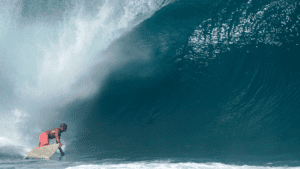
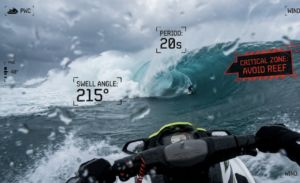
But for the truly dedicated, the search for bigger thrills leads to spots known for their more substantial waves. Take Teahupo’o in Tahiti, for example. Here, waves generally reach around 8 metres. While that might sound huge to the uninitiated, seasoned surfers know this is where things start to get serious. The unique funnel-shaped reef at Teahupo’o concentrates the wave power, creating incredible barrelling waves (what some might call a “lip” or “tube”) that are both beautiful and incredibly dangerous. Despite their relatively smaller height compared to other behemoths, these waves are fast, steep, and have claimed the lives of at least five surfers since 2000. The annual Billabong Pro Tahiti (now possibly the Shiseido Pro) highlights the prestige and danger of this spot, where no casual swimmers are allowed in the water during competitions.
Pushing the Limits: Banzai Pipeline and Beyond
Moving beyond Tahiti, Pupukea on the north shore of Oahu, Hawaii, home to the legendary Banzai Pipeline, is often cited as hosting some of the most dangerous rideable waves in the world. This spot, with a name that itself suggests danger, became a frontier for brave Hawaiian surfers in the 1950s, pushing the boundaries beyond the previous perceived limit of around 3 metres.
The danger at Banzai Pipeline stems from its unique reef structure. Three distinct reef layers, each deeper than the last as you move away from the shore, cause approaching ocean swells to hit the shallow seabed in stages. This sudden decrease in depth forces the wave’s energy upwards, resulting in thick, heavy, and barrelling waves that can reach over 6 metres in areas like Off The Wall and Backdoor. This illustrates a crucial concept: the shallower the water becomes, the more violently the wave will express its power on the surface.
Monster Waves in the Open Ocean
Even in the open ocean, far from coastlines, massive waves can form. While normal high seas can see waves of over 15 metres, exceptional conditions can lead to truly monstrous waves appearing seemingly out of nowhere. This can happen when multiple waves converge and amplify their height and power. A chilling example is the 26-metre rogue wave recorded by a monitoring platform off the coast of Norway on New Year’s Eve 1995. To put that in perspective, that’s as tall as the Brandenburg Gate in Berlin or the Arch of Constantine in Rome. These are not the kind of waves anyone would willingly paddle out into!
Nazaré: The Current Frontier of Big Wave Surfing
For surfers chasing the absolute limit of what’s rideable, the small town of Nazare in Portugal has become the epicentre. Over the last 50 years, this former fishing village has transformed into a big wave surfing mecca. The reason? A remarkable underwater feature: the Nazare Canyon, a 230-kilometre long trench that ends near the coast.
Normally, waves approaching the Portuguese coast are generated over a seabed with an average depth of around 20 metres. However, directly in front of Praia do Norte beach in Nazaré, the seabed plummets from 200 metres within the canyon to 0 metres at the shoreline. This dramatic change in depth creates monstrous waves.
It’s at Nazaré that legends are made. In 2011, Garrett McNamara successfully surfed a 24-metre wave, setting a world record. Not content with that, in 2013, he claimed to have ridden a 30-metre wave at the same location, although this wasn’t officially certified. In 2020, Portuguese surfer António Laureano reportedly rode an estimated 31-metre wave in Nazare. However, the currently certified tallest wave ever surfed belongs to German surfer Sebastian Steudtner, who rode a 26.21-metre wave in Nazare in 2020.
The immense height of these waves at Nazaré is due to the way the wave “mounts” as it encounters the rapidly rising seabed of the canyon. This is a location where the most talented and fearless surfers in history continue to push the boundaries.
The Unthinkable: Lituya Bay’s Mega-Tsunami
Finally, we come to the undisputed record holder for the highest wave ever recorded: the mega-tsunami of Lituya Bay, Alaska, in 1958. This event produced a wave that reached an astonishing 524 metres in height. To put that into perspective, that’s taller than the Empire State Building!
This colossal wave wasn’t caused by an earthquake directly, like typical tsunamis. Instead, it was triggered by a massive rockfall – around 40 million cubic metres of rock – plunging 600 metres into the bay, striking the Gilbert Glacier and creating an unbelievably powerful wave.
While the 524-metre wave in Lituya Bay is a record of unimaginable scale, it’s crucial to understand that this was a catastrophic event, not a wave that could ever be surfed.
Conclusion
Exploring the world of the biggest waves, from the challenging barrels of Teahupo’o and the treacherous reef breaks of Banzai Pipeline to the record-breaking giants of Nazaré and the unbelievable mega-tsunami of Lituya Bay, offers valuable insights for surfers of all levels. Understanding wave dynamics, the impact of underwater topography, and the sheer power the ocean can unleash is crucial for safety and appreciation of our sport. While most of us will never face a 30-metre wave, understanding the forces at play in these extreme conditions can deepen our respect for the ocean and the incredible energy it holds.
So next time you’re paddling out, remember the spectrum of waves out there. From the playful ripples to the awe-inspiring mountains of water, the ocean always has more to teach us. Keep charging, stay safe, and who knows, maybe one day you’ll find yourself at the foot of your own personal giant.
Don’t forget to subscribe to Surf Hungry Youtube Channel channel for more fascinating stories and ocean insights!
FAQ: The Biggest Waves on Earth
🌊 What is considered a “big wave” in surfing?
Generally, waves over 6 metres (20 feet) are considered “big waves” in the surfing world. These require specialized training, equipment, and safety teams. Anything under that might still feel huge to most people—but it’s the real monsters that demand respect and experience.
🌀 Why do some places have bigger waves than others?
It all comes down to underwater topography (like reefs and canyons), wind conditions, and storm systems. For example, Nazaré’s underwater canyon funnels and amplifies swells into giant waves, while reef breaks like Teahupo’o produce short, powerful barrels.
⚠️ Are big wave surf spots safe for beginners?
Absolutely not. Big wave spots like Banzai Pipeline or Nazaré are dangerous even for pros. Beginners should always stick to mellow beach breaks, build experience, and never paddle out alone.
🏄 Has anyone ever surfed a tsunami?
No—and they never should. Tsunamis are not surfable waves; they’re walls of water moving inland at terrifying speeds with deadly force. Unlike ocean swells, they don’t form surfable faces.
⛏️ What causes rogue waves in the ocean?
Rogue waves form when multiple waves converge and constructively interfere, resulting in a single, giant wave that seems to come out of nowhere. They can be over twice the height of surrounding waves and are extremely dangerous for ships and offshore structures.
🏆 What is the tallest wave ever surfed?
As of now, the official record belongs to Sebastian Steudtner, who surfed a 26.21-metre (86-foot) wave in Nazaré, Portugal, in 2020. It’s an insane feat that pushed the limits of what’s possible in big wave surfing.
❄️ What happened in Lituya Bay, Alaska?
In 1958, a massive rockfall triggered a mega-tsunami in Lituya Bay, producing a wave estimated at 524 metres (1,720 feet). It’s the tallest wave ever recorded—but not one born from surfable ocean swell. It was a natural disaster, not a surf session.
📹 Where can I see these waves in action?
Check out documentaries, surf competitions, and daily surf clips on channels like Surf Hungry’s YouTube. You’ll find firsthand footage of Nazaré giants, Teahupo’o barrels, and more jaw-dropping wave action.
Luke Morris is an avid athlete and the driving force behind Surfhungry, a vibrant online platform dedicated to sharing the joy and passion of surfing and water sports with enthusiasts around the world. With a deep-rooted love for the ocean and a lifelong commitment to riding waves, Luke’s journey as a surfer has inspired him to create a community where like-minded individuals can come together to celebrate their shared passion.