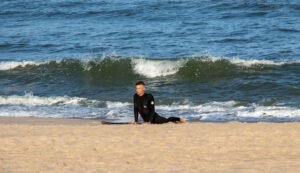

Surfers (from total beginners to weekend chargers) often show up to the beach with a noisy mind, a stiff body, and a vague plan—then wonder why the first 20 minutes feel sketchy. The ocean doesn’t care if you’re stressed, caffeinated, or rushing; it just keeps moving. A few simple rituals can help you arrive calm, prepared, and tuned in, so you surf better and make safer choices.
Table of Contents
The quick take
A good pre-surf routine does three things: it reduces risk, steadies your nerves, and primes your body to paddle and pop up smoothly. You don’t need a complicated ceremony—just a repeatable sequence you can do even when you’re late. If you remember nothing else: check conditions, warm up shoulders/hips, and take 60 seconds to breathe on purpose.
Start with the ocean, not your ego.
Before the stretches, before the hype playlist—look at the water like you’re reading a mood.
- Sets: Are there lulls and pulses? Where are waves breaking consistently?
- Currents and channels: Where’s the water moving? Where are people paddling out successfully?
- Entry/exit: If you get worked, where do you safely end up?
- Your honest comfort zone: Today is not the day to “prove” something.
A small table of rituals (choose what fits your day)
Think of this like a menu. You can mix and match, but keep it consistent enough that your brain recognizes: we’re surfing now.
| Ritual | What it supports | When it’s most useful |
| Slow deep breathing | Lowers panic, improves focus | Nerves, crowded lineups |
| Shoulder + thoracic warm-up | Easier paddling, fewer tweaks | Cold mornings, long paddles |
| Hip/ankle mobility | Faster pop-ups, smoother stance | Stiff lower body, tight wetsuit |
| “Plan the session” glance at conditions | Safety + smarter positioning | New spot, shifting peaks |
| Light caffeine (optional) | Alertness, motivation | Dawn patrol; avoid if it spikes anxiety |
| Short intention (“one thing”) | Confidence and clarity | When you feel scattered |
Morning momentum that actually carries into the lineup
How you start your day often decides whether you show up hurried and reactive—or steady and ready. A tiny dose of optimism can be surprisingly practical: it makes you more patient in crowds, more consistent in your breathing, and less likely to spiral after a wipeout. One easy place to borrow ideas is simply starting your day with some positive input. A few simple options (pick what feels natural, not cheesy):
- Read a short inspirational passage (one page, not a whole book)
- Write three gratitude bullets (fast, messy, honest)
- Sit for 2 minutes and notice your breath without “fixing” it
- Take a short walk outside before screens
- Write one sentence: “Today’s session will be successful if I ______.”
The point isn’t perfection—it’s setting your nervous system to “open and alert,” not “braced and frantic.”
The 10-minute shore routine (a simple how-to)
Use this when you want structure without overthinking.
- Look for hazards first (60 seconds). Identify current direction, rip channels, and your exit zone.
- Loosen your neck and shoulders (90 seconds). Gentle circles; then scapular squeezes (pull shoulder blades down/back).
- Open your chest and upper back (90 seconds). Hands behind head, rotate slowly side to side; a few big breaths.
- Prime hips and ankles (2 minutes). Leg swings, slow air squats, calf raises—nothing aggressive.
- Do 20 seconds of “pop-up rehearsal.” One slow, clean pop-up. Then one at normal speed.
- Breathe like you mean it (60 seconds). Inhale 4, exhale 6. Longer exhales signal “we’re okay.”
- Pick one intention (10 seconds). Examples: “Relax my shoulders,” “Commit to the takeoff,” “Stay wide of the pack.”
- Final conditions check (60 seconds). Confirm where you’ll paddle out and where you’ll sit. Then go.
A surfer’s “quiet mind” kit for managing anxiety
Surf anxiety is normal. It can show up as shallow breathing, tense paddling, rushing takeoffs, or bailing early. A useful trick: don’t argue with the feeling—give it a job.
- Name it: “I’m amped.” (Not “I’m doomed.”)
- Slow the first paddles: Treat them like warm-up strokes, not a race.
- Use a reset cue: Touch the wax, adjust the leash, or dunk your face—something that anchors you.
If coffee helps you feel awake and confident, great. If it turns your nerves into a hummingbird, consider half-caf, tea, or saving caffeine until after you’ve been in the water for a few minutes.
A practical online resource worth bookmarking
If you surf anywhere with shifting sandbars, jetties, or punchy shorebreak, rip-current literacy is not optional—it’s part of surfing well. NOAA’s rip current safety page is a clean, non-dramatic overview you can skim in a few minutes and actually remember. It explains what rip currents are, how to spot warning signs, and what to do if you’re caught (including the common-sense reminder to stay calm and conserve energy). Sharing it with a friend who’s new to the ocean is also a low-key way to keep the whole crew safer.
FAQ
How long should a pre-surf ritual take?
Anywhere from 3 to 15 minutes. Consistency matters more than length—your brain learns the sequence and starts “downshifting” into focus.
What if I’m short on time?
Do the essentials: quick conditions scan, shoulder warm-up, 60 seconds of breathing, and one clean pop-up rehearsal.
Should I always check tides and currents?
If you can, yes—especially at unfamiliar spots.
How do I check surf conditions quickly?
Many surfers use surf reports and forecasts to get a fast read on swell, wind, and tide context, then confirm it with their eyes at the beach. Surfline is one widely used option.
Conclusion
A pre-surf ritual isn’t superstition—it’s a repeatable way to arrive prepared, calm, and capable. When you check the ocean first, warm your key joints, and regulate your breathing, you’re more likely to surf with confidence and make safer decisions. Keep it simple enough that you’ll actually do it on messy days. Then let the water take it from there.

Luke Morris is an avid athlete and the driving force behind Surfhungry, a vibrant online platform dedicated to sharing the joy and passion of surfing and water sports with enthusiasts around the world. With a deep-rooted love for the ocean and a lifelong commitment to riding waves, Luke’s journey as a surfer has inspired him to create a community where like-minded individuals can come together to celebrate their shared passion.