
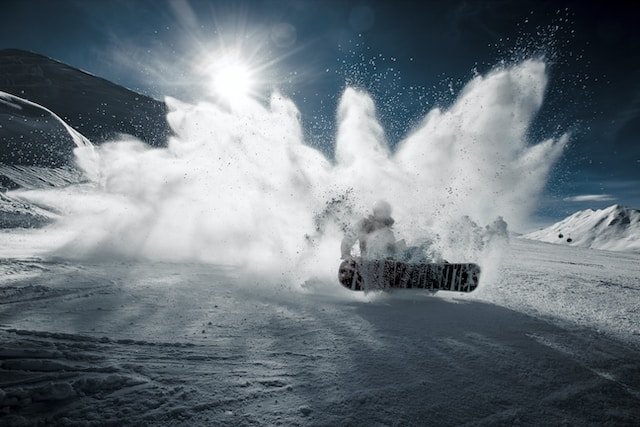
Snowboarding and surfing are both considered extreme sports, and they are both totally epic when it comes to sporting exhilaration. Although one is water-based and the other land-based, both sports use a board and require considerable balance and skill, so how do they compare?
Snowboarding and surfing, although similar in terms of the use of a board and the need for balance, are two very different sports with different muscular and skill requirements. After all, surfing is done in the water, while snowboarding is done on land.
We will look at how surfing and snowboarding are similar and different and see if proficiency in one will help you learn the other and if the skills and techniques are easily transferable from the slopes to the waves.
Table of Contents
How Are Snowboarding And Surfing Similar And Different?
If you have never done either sport, you won’t be blamed for thinking that to be able to surf is to be able to snowboard and visa versa; even surfers and snowboarders may often think that moving into the other sport will be a breeze.
The reality is somewhat different, thanks to several factors. The first is the terrain; obviously, there is a vast difference between standing on a board in the water and standing on a board in the snow.
Surfing vs. Snowboarding Difficulty?
Surfing is more challenging to get correct than snowboarding; there is just a lot more to consider. Getting the surfboard out to the waves is one issue; it involves some severe paddling and arm strength. Then there is being able to read the waves.
And then, after getting it right with wave choices, there is still catching the wave, dropping into it, and getting to your feet. Once you have it right, it’s like pure magic, but getting there takes a lot of practice.
When learning to surf, it is not easy to fall and try again like on a slope; you will need to paddle out, wait for the right wave, and sometimes not even get a few seconds on your feet before you fall off again.
Surfing requires considerable repetition, which can be incredibly tiring. But on the plus side, severe injury is less likely as when you fall, you fall into the water, whereas a fall in snow can be pretty serious, particularly when there isn’t much powder and more ice.
This does not mean that it doesn’t take skill to snowboard; it does. It will still take much practice to get your weight placement right on your snowboard and learn when to lean back and forward without planting the edge.

Does Snow Boarding Help With Surfing?
Someone who has snowboarded will have an easier time learning to surf than someone with no board sports background.
Both snowboarding and surfing use core muscle stability, and that does help the transfer from one element to another. Balancing skills and knowledge of how best to position one’s body when snowboarding is important. That can also be useful in surfing, although this skill must adapt to water conditions.
Is Snowboarding Easy If You Surf?
The transition from surf to snow will likely be smoother than snow to surf, mainly because of the environmental change. It is easier to balance and stand on land than on water. You will need to acclimatize to a different-sized board and how it should be used in the snow.
One sure thing is that if you enjoy one board sport, you will love the other; both surfing and snowboarding are exhilarating and delightful activities, and if you can do both, you get to enjoy the best of beach and mountain sports.
Those who have mastered both sports can do what is called a California Double, Daily Double, or ‘Twofer,’ which is going for a surf and then snowboarding on the same day, which, while quite tiring, is one of the best things anyone who enjoys an active life can do.

Is Surfing More Like Skateboarding Or Snowboarding?
Surfing is a very different type of board sport, and when bringing in comparison with snowboarding and skateboarding, skateboarding has an unfixed footing, making it similar to surfing. Otherwise, snowboarding and skateboarding are much more similar to each other than surfing is.
Surfing vs. Skiing
Surfing and skiing may be considered vastly different, but in fact, they share more than one may think, as they both require the use of arms and legs. Both sports use core stability and leg strength to get moving, but neither do they need arm strength.
Surfing and skiing also require forward pressure on the board or skis to produce speed and maintain control. Surfing is a decidedly more relaxed and down-to-earth sport, with skiing having closer associations with wealth and privilege.
Is Surfing Safer Than Snowboarding?
When it comes to practice, surfing is safer than snowboarding when it comes to serious injury; falling in the water is a lot safer, and surfers are much less likely to pick up an injury from falls. This can be quite variable as some surf spots are near rocky reefs, and the risk of injury is high in these cases.
An added danger when surfing is drowning, which is not possible on land. On the other hand, snowboarding has a higher overall chance of injury from falls. And depending on slopes and jumps, there is always the danger of running into trees or boulders, and of course, avalanches will also be a threat in wilder areas.
Snowboarding And Surfing: Similarities And Differences
Let’s look at the factors that show the significant differences and similarities between snowboarding and surfing:
Equipment: How Do The Boards Differ In Terms Of Shape, Size, And Design?
When one compares snowboarding and surfing, equipment is a big difference. Surfboards vary in size from longboards to much smaller, faster competition boards. Regardless of the board type, surfboards are considerably broader and larger than snowboards which are more similar to skateboards in shape, size, and design.
The only similarity in equipment is that a board of sports is used; other than that, equipment-wise, surfing requires some shorts or a bathing suit and, maybe in cold water, a wetsuit, whereas snowboarding needs a warm helmet snow clothes, boots, and UV proof goggles. All in all, snowboarding is a significantly more costly sport.
Environment: How Does The Terrain And Weather Impact The Two Sports?
The environment is the most apparent difference between surfing and snowboarding. Surfing is done in the ocean or bodies of water with waves, while snowboarding occurs most commonly on mountain slopes with sufficient snowfall.
Because of the terrain types, surfing is more commonly practiced in summer, while snowboarding is enjoyed in winter. That said, in many places in the world, the winter can be very mild, allowing for surfing year-round, and some people will be willing to brave chilly water with wetsuits.
Both sports are unlikely to be practiced in severe weather, although surfers will still head out in light rain.
Techniques
While footing is different, snowboarding and surfing have similar moves, particularly regarding core stability.
Surfing requires centering your weight on the back foot and transferring it forward when speeding up, snowboarding is more centrally based, and in both sports, you will use your body and legs for movement.
One thing I can mention is the waxing of the board – surfing requires the wax on top of the board as this provides a better surface grip for your feet, whereas snowboarders will apply wax beneath their boards as this helps to give a better surface for slipping over the snow.
How Snowboarding Helps With Surfing And Vice Versa
There is a decided growth in surfing and snowboarding crossover, and it is no surprise as both sports have different benefits while giving a feeling of similarity. Snowboarding offers surfers an excellent way to remain upright for longer and provides a change of scenery.
The same can be said for surfing, where snowboarders need to develop better arm strength, and the coast is the perfect summer destination in summer, so what’s not to like?
Surfing vs Snowboarding: Which Is More Fun And Why?
Comparing surfing against snowboarding in terms of fun could work better, as it largely depends on each person and their preferences. Both sports are fun and offer sufficient challenge and enjoyment.
Which Sport Is More Accessible And Easier To Learn?
Regarding accessibility, surfing is easily the more accessible sport, provided you can get to a beach. With minimal kit and equipment required, learning to surf takes a lot of practice and patience.
Snowboarding requires more in terms of equipment due to the freezing temperatures as well as the dangers. Ski slopes require passes and ski lifts, which add to the expense. However, learning to snowboard is easier as you can spend more time practicing on the board.
A significant challenge about surfing is the water; surfers need to be able to swim pretty well and need to be able to paddle their way out to the back line. And once out there, they need to be able to read the swell to know which waves are worth dropping in on.
While this can take a while to learn, it’s well worth it; nothing is more invigorating than going for a surf; even if you only catch a wave or two, the entire experience is refreshing. The ocean breeze, the beauty of the surf, and, if you’re lucky, you may even experience dolphins playing nearby.
Snowboarding’s biggest challenge is the cost, but if it is a possibility, it’s a fantastic way to keep fit during winter, and crushing it on the slopes for a day is a beautiful feeling, mainly if there is some fresh powder on the slopes.
This brings us to how the different snow or waves affect your overall experience. Fresh soft snow can’t be beaten when it comes to snowboarding. It’s easier to snowboard in and a lot kinder on the body when you fall. Icy conditions are punishing, and you can expect some bruising after falling.
Surfing is no fun without waves; as much as the paddle out and sitting waiting can be relaxing and social, the sport is about catching the right wave. Too small a wave won’t give much of a ride. Too large a wave may be dangerous, and when it’s a ton of foam, it’s not much use. The key is to catch the wave as it breaks.
How Do The Locations And Cultures Of Snowboarding And Surfing Destinations Differ?
The beach vibe is relaxed and chilled, and there is a reason why surfers are predominantly portrayed as super laid-back in the media. The most glaring difference is the location. Surfing destinations are beach-based, and surfers will travel around the globe to the top surf spots to catch a sound wave.
Surf culture is inclusive and accepting and goes beyond the sport itself. Surfers have a strong affinity with the ocean, and many will note that surfing has a spiritual aspect. Environmentalism is a critical component of surf culture thanks to its close interaction with nature.
Snowboarders, like surfers, have a good community. Snowboarders can be equally environmentally conscious and share this affinity to nature. Snowboarders are about self-expression through sport; your ride on the slop is a way to show your individualism within a close-knit community.
The Connection Between Surfing, Skateboarding, And Snowboarding
Skateboarding is the other board sport, and like snowboarding and surfing, it’s also considered to be on the extreme side. It shares the other two board sports’ more casual, fun, individual-based but community-bound culture.
The boards of skating and snowboarding are much more similar than that of a surfboard in size, material, and shape. Surfboards are bigger and broader, and thicker as they have to provide sufficient buoyancy in the water.
Surfing and skating allow for more foot movement as feet are not fixed to the board as in snowboarding, so there is more movement available. All three sports use the legs and core to direct the board.
Tips For Transitioning Between Snowboarding And Surfing
The first thing to remember when transitioning from surfing to snowboarding or vice versa is that you must engage different muscles and get used to a different environment. Surfers will have an easier time but will still need to adapt to being unable to move their feet.
If you are moving from snow to surf, be prepared to use your arms more and swallow a fair amount of salt water when first starting. It takes time, but you will eventually learn to read waves and get ducking beneath them right.
Moving from snowboarding, all you need is a surfboard and a will to surf; I recommend doing a few lessons if there is time, as instructors can assist a lot in getting your balance and timing right. When it comes to reading the waves, well, that’s a lifelong pursuit.
Moving from snowboarding does require learning the slopes, getting used to fixed feet, and forking out way more cash than they previously used to for ski lifts.
As with every transition, be prepared to learn through failure; you won’t get it right the first time but use the errors to learn and, of course, have fun.
From Slopes To Swells: How To Surf And Snowboard In One Day
The California Double or Twofer is very doable. I can guarantee that sleep will be excellent that night, as taking on both a surf and snowboarding session in one day is quite strenuous.
Logistics are a significant factor, as getting from sea level to a mountain high enough to have good powder in a single day is easier said than done. A Twofer is possible in several places in the world. New Zealand, Australia, France, Morocco, Iceland, Chile, Lebanon, and Morocco have geography that allows for the feat.
The US is also amongst the Twofer crew, and California is one of the states allowing it, with the State being the source of the name California Double.
In the US, California is surf central, and you can get your California Double in by trying out these awesome combinations:
- Malibu and Mount Baldy
- Ocean Beach and Boreal
- Huntington Beach and Mountain High
- San Clemente and Bear Mountain
When getting both sports in, it takes a bit of planning; either you need to have all your gear ready and packed to go, or you may need to pre-arrange hiring your snowboard and equipment for when you hit the slopes.
When taking on both surf and slopes, the biggest issue is doing it appropriately; make sure you give yourself time between the sessions for recovery and keep hydrated.
Conclusion
Surfing and snowboarding are two of the most enjoyable board sports, and by learning both disciplines, one can enjoy the best of mountain and sea.

Luke Morris is an avid athlete and the driving force behind Surfhungry, a vibrant online platform dedicated to sharing the joy and passion of surfing and water sports with enthusiasts around the world. With a deep-rooted love for the ocean and a lifelong commitment to riding waves, Luke’s journey as a surfer has inspired him to create a community where like-minded individuals can come together to celebrate their shared passion.