
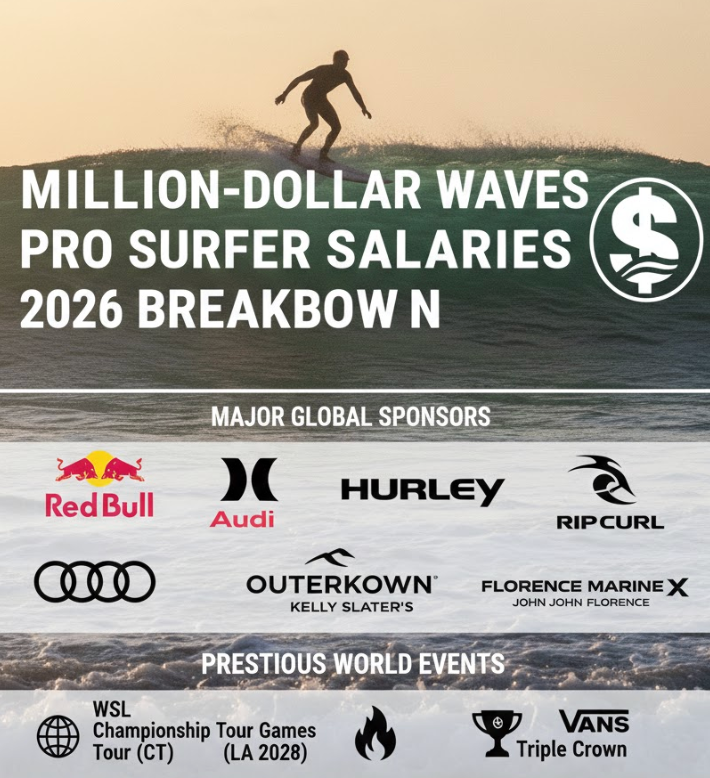
In 2026, a top-tier professional surfer on the World Surf League (WSL) Championship Tour earns an average of $350,000 to $600,000 USD annually. However, elite “megastars” like John John Florence and Gabriel Medina exceed $5 million+ through private brand ownership and global endorsements. Revenue is now split across four main pillars: WSL Prize Money, Endorsement Contracts, YouTube/Social Media Ad Sense, and Personal Brand Equity.
Table of Contents
Introduction
Surfing is no longer just a recreational pastime; in 2026, it is a multi-billion dollar pillar of the global sports industry. Following the massive success of surfing in the 2024 Paris Olympics and the lead-up to LA 2028, the financial landscape for pro surfers has shifted from simple “stickers on boards” to complex multi-platform media deals.
To most of us on the sidelines, professional surfing looks like surfers hanging out and waiting until their turn to paddle out and surf. We think pro surfers traveling to exotic destinations almost every month, appearing in surf magazines, and partying.
“This is the life,” you might say. Is it really so? Is it worth it? It may look like the “dream job.” After all, who doesn’t want to get paid to catch waves? But did you ever wonder how to be a pro surfer, how pro surfers make money and how much they earn a year? In this article, we’ll find out:
- How much do pro surfers make?
- Pro Surfing’s Highest Earners and Highest Net Worth 2021-2026
- When Is a Surfer Considered a Pro Surfer?
- Popular Surfing Competitions
The 2026 Earnings Breakdown at a Glance
-
Elite (Top 10 WSL): $2M – $6M+ USD/year
-
Mid-Tier (Championship Tour): $350,000 – $750,000 USD/year
-
Qualifying/Challenger Series: $20,000 – $60,000 USD/year (Often operating at a net loss)
-
Free Surfers (Content Creators): $100,000 – $1M USD/year (Based on views/subscribers)
How Do Surfers Get Paid?
Pro surfers devote their lives not only to traveling and riding the waves but to day-to-day surf training, too. They wake up at 6 in the morning every day to train, be fit, and be ready for the next competition. But are they earning enough to compensate for their daily challenges?
Pro surfers, especially those who are ranking, earn prize money, which can add up to a respectable sum when combined with sponsorship income.
Prize Money and Surf Contest Winnings
In 2011 Owen Wright took home $300,000 in what is the biggest prize purse ever won by a professional surfer. The event was his first ever WCT event win held at Long Island, New York.
Despite this hefty example, contest winnings make up the tiniest part of a pro surfer’s income. For instance, the Vans US Open of Surfing, one of the biggest surfing competitions, sponsored by the mega-company Vans, gives a first-place cash prize in the USD $20,000 range (with equal prize money for both male and female surfers).
That makes you wonder how many competitions does an average pro surfer wins if he earns about $250,000 to $400,000 a year? In reality, pro surfers don’t need to win massive amounts in competitions per year to be part of the top echelon of pro surfers.
In professional surfing, how brands regard you matters just as much if not more than the titles you bring home.
So, if a pro surfer doesn’t win the contest, how much money does he or she make? The cash prizes tend to dwindle after the top five contestants.
These numbers are why surfers tend to rely more on sponsorships to make it to the top of the highest-earning surfers’ list.
Sponsorships
Aside from competition earnings, pro surfers earn money by representing brands. This representation bound by signed contracts and agreements is called sponsorship, much like how the brand Vans sponsors the Vans US Open, only the brand sponsors individual surfers who have been recognized as best of the best. The most lucrative sponsorship deal in history was a $30 million-dollar, 8-year deal given to Jon Jon Florence (pre Covid pandemic) by Hurley. This deal saw Jon Jon net $5,300,000 per year in sponsorship money alone!

The brand sponsorship pays the pro surfers to bring publicity to the company. The pro surfers get to travel to different surfing locations and surf. They take video footage and photos of their surf trip that the brand uses to generate buzzworthy content.
Joel Parkinson, an Australian surfer who used to compete on the World Surf League, was reported to have signed a contract with Billabong in 2008 for $1.5 million over five years. Imagine what that would be worth today, in 2026! Best known for his unprecedented 11 world surfing championships, Kelly Slater made a sponsorship deal with Quiksilver for $2 million over five years, again, imagine what sort of money that would equate to today!
Products
Another way pro surfers earn money is from products that bear their name. Australian magazine “Stab” reported Mick Fanning’s earnings of more than $450,000 in 2008 from the Reef sandal he helped design. Mikael Pikon makes money from the surfing underwear he designed with a well-known brand. Dane Reynolds also gets royalties from the surfboards that bore his signatures.
In 2026, surfers sign “Category Specific” deals. A pro might have separate contracts for:
-
Technical Gear: (Wetsuits/Boards)
-
Lifestyle/Luxury: (Audi, Breitling, or Ralph Lauren)
-
Wellness/Tech: (Whoop, Apple Watch, or Athletic Greens)
YouTube Earnings
Digital projects also add up to the earnings of pro surfers. Their footages uploaded on video sharing platforms like YouTube rake them salaries, too. So much that it can be surprisingly more than average competition winnings. Surfers who have high followings across social media, like Jamie O’Brien, can make money based off of their personal platforms even if they’re not competing.
In 2026, a surfer with 500k subscribers can generate $15,000–$30,000 USD monthly in AdSense and integrated “collabs,” often out-earning surfers ranked in the Top 20 on the competitive tour.
Personal Brand Equity (The “JJF” Model)
The biggest shift in 2026 is surfers owning their own brands rather than just being “billboards.” John John Florence’s Florence Marine X and Kelly Slater’s Outerknown represent the new pinnacle of surfing wealth—building a company you own vs. a contract you sign.
Pro Surfing’s Highest Earners and Highest Net Worth 2021-2026
We’ve done as much digging around as we can to put together this list referencing the highest paid surfer’s earnings and estimated net worth in $USD. We’ve added the date last referenced so you know how current these earnings are:
- Kelly Slater: Estimated net worth $30 million (2026). During his illustrious 30-year career with over 60 event wins Kelly Slater has earned $4,071,360.
- John John Florence: Estimated net worth $18 million (2026). The most lucrative sponsorship deal in history was a $30 million-dollar, 8-year deal given to Jon Jon Florence (pre Covid pandemic) by Hurley. This deal saw Jon Jon net $5,300,000 per year in sponsorship money alone.
- Gabriel Medina: Estimated earnings in 2026: $12million. Gabriel Medina was the highest paid surfer in 2022, netting his $2.2 million dollars from major sponsors like Rip Curl, Corona, Audi, Ralph Lauren and more.
- Mick Fanning: Estimated net worth $8 million (2026). Mick Fanning was the second highest paid surfer in 2022, with the 3x world champion netting $1.8million dollars in the year 2022.
- Joel Parkinson: Estimated net worth $3 million (2026)
- Stephanie Gilmore: Estimated net worth $3 million (2026)
- Julian Wilson: Estimated net worth $2.1 million (2026)
- Kanoa Igarashi Estimated earnings $1.7 million (2021)
- Filipe Toledo: Estimated earnings $1.75 million (2021)
When Is a Surfer Considered a Pro Surfer?
Professionally, pro surfing is a pretty new thing. Professional surfing includes those whose careers started when the ASP World Tour began in the early 1980s. Currently, there are more or less 2,000 professional competitive male and female surfers around the world.
But, there are only about 7.5% or 150 of them who make a living off surfing professionally. A pro surfer’s monthly salary or annual income varies significantly on whether he is competing at an elite level or still scuffling to top the qualifying series rankings.
Popular Surfing Competitions & Their Economic Impact
The World Surf League Championship Tour (CT)
The World Surf League Championship Tour (CT) stands as the pinnacle of professional surfing, featuring the world’s top male and female surfers battling it out at iconic breaks across the globe. With locations ranging from the thundering barrels of Pipeline in Hawaii to the flawless walls of Bells Beach in Australia, the CT offers a diverse and challenging lineup of waves that test the skills and mettle of the world’s best.
Each CT season is a rollercoaster ride of drama, excitement, and unforgettable moments. From epic clashes between rivals to stunning performances by underdogs, the CT never fails to deliver pulse-pounding action and jaw-dropping maneuvers that leave fans on the edge of their seats.
The Vans Triple Crown of Surfing
The Vans Triple Crown of Surfing is a prestigious series of events held on the North Shore of Oahu, Hawaii, each winter. Comprising the Hawaiian Pro, the Vans World Cup, and the Billabong Pipe Masters, the Triple Crown showcases the raw power and beauty of surfing in some of the most challenging conditions on the planet.
Winning the Vans Triple Crown is a crowning achievement for any surfer, requiring skill, determination, and a deep understanding of the North Shore’s fickle waves. Past champions include legendary figures like Kelly Slater, Andy Irons, and John John Florence, whose mastery of Pipeline and Sunset Beach has earned them a place in surfing history.
The Rip Curl Pro Bells Beach
The Rip Curl Pro Bells Beach is one of the longest-running surfing competitions in the world, with a history dating back to 1961. Held annually at the iconic Bells Beach in Victoria, Australia, the event is renowned for its challenging waves, stunning scenery, and unique Easter weekend atmosphere.
Victory at Bells Beach is a cherished achievement for any surfer, symbolizing mastery of one of the sport’s most revered breaks. Past champions include surfing legends like Mark Richards, Kelly Slater, and Stephanie Gilmore, whose names are etched in the annals of surfing history alongside the ringing bells of victory.
The Quiksilver Pro France
The Quiksilver Pro France is Europe’s premier surfing event, held annually in the picturesque seaside town of Hossegor. Known for its powerful beach breaks and challenging conditions, the event attracts the world’s best surfers, who compete for glory in the pounding surf of La Gravière.
The Quiksilver Pro France is not just a test of skill and athleticism; it’s a celebration of surfing culture and style. From the laid-back vibes of the Landes region to the chic sophistication of Biarritz, the event embodies the unique blend of surf, art, and lifestyle that defines the French surfing experience.
The Olympic Effect
In 2026, surfers representing countries like the USA, Brazil, and Japan receive Governmental Stiped Funding and “Gold Medal Bonuses” that can reach $50,000 – $100,000.
The Reality Check: The Cost of Being Pro
While the top 1% are wealthy, the “Middle Class” of surfing is struggling with 2026 inflation.
-
Travel Costs: $50,000–$80,000/year (Coaches, flights, board bag fees).
-
Entry Fees: $2,000–$5,000/year.
-
The Gap: A surfer ranked #50 in the world often makes $0 profit after expenses, relying on local “Shop Sponsors” and side-hustles like surf coaching.
Wrap Up
Brand sponsorships and winnings can earn pro surfers at least a million dollars or more each year. It is estimated that surfers on world tours make between $350,000 to $600,000 USD annually.
However, pro surfers also have to shell out hefty expenses to travel and compete around the world. They also cover the cost of equipment, entrance fees, and dues. Sometimes, sponsors provide equipment, but most of the time, pro surfers foot their own bills.
In short, it’s not all sunshine and roses. There are certainly pro surfers who are living the dream we can only fantasize about. But, there are also those still on the treacherous road like pro surfer Dayyan Neve who in 2007 spent $100,000 of his own money to pay his way to competitions only to win $70,000.
FAQs (Frequently Asked Questions)
Q: How do pro surfers earn money?
A: Pro surfers earn money through sponsorships, prize money from competitions, media deals, and influencer marketing.
Q: Do male and female surfers earn the same amount?
A: Up until the fall of 2018, equal pay for male and female surfers wasn’t a given. However, on September 5, 2018, the WSL declared that all surfers would receive equal pay regardless of gender. According to the World Surf League rulebook, each Men’s Championship Tour takes a total prize of $607,816. This amount gets divided into 36 competitors. On the contrary, the Women’s Tour only has half the number of competitors making the prize cut in half, too – $303,908. Female pro surfers can decide how the prize money is allocated, so most of the time, it is spread in a more even way than male prize money. For example, the difference in prize winnings between 1st and 13th for women’s events equates to $55,000, wherein the men’s tour has a difference of $88,500.
Q: Do all pro surfers make a lot of money?
A: Not all pro surfers make substantial earnings. Success in professional surfing depends on factors like skill level, marketability, and competition results.
Q: Can you become a pro surfer without sponsorships?
A: While sponsorships can provide financial support, some pro surfers rely solely on prize money and other income streams to sustain their careers.
Q: What expenses do pro surfers have?
A: Pro surfers incur expenses such as travel, equipment, training, and competition entry fees.
Q: Are there opportunities for aspiring surfers to turn pro?
A: Yes, aspiring surfers can pursue a professional career by competing in contests, gaining exposure, and securing sponsorships.
Q: How competitive is the professional surfing circuit?
A: The professional surfing circuit is highly competitive, with athletes vying for top rankings and coveted sponsorships.

Luke Morris is an avid athlete and the driving force behind Surfhungry, a vibrant online platform dedicated to sharing the joy and passion of surfing and water sports with enthusiasts around the world. With a deep-rooted love for the ocean and a lifelong commitment to riding waves, Luke’s journey as a surfer has inspired him to create a community where like-minded individuals can come together to celebrate their shared passion.