
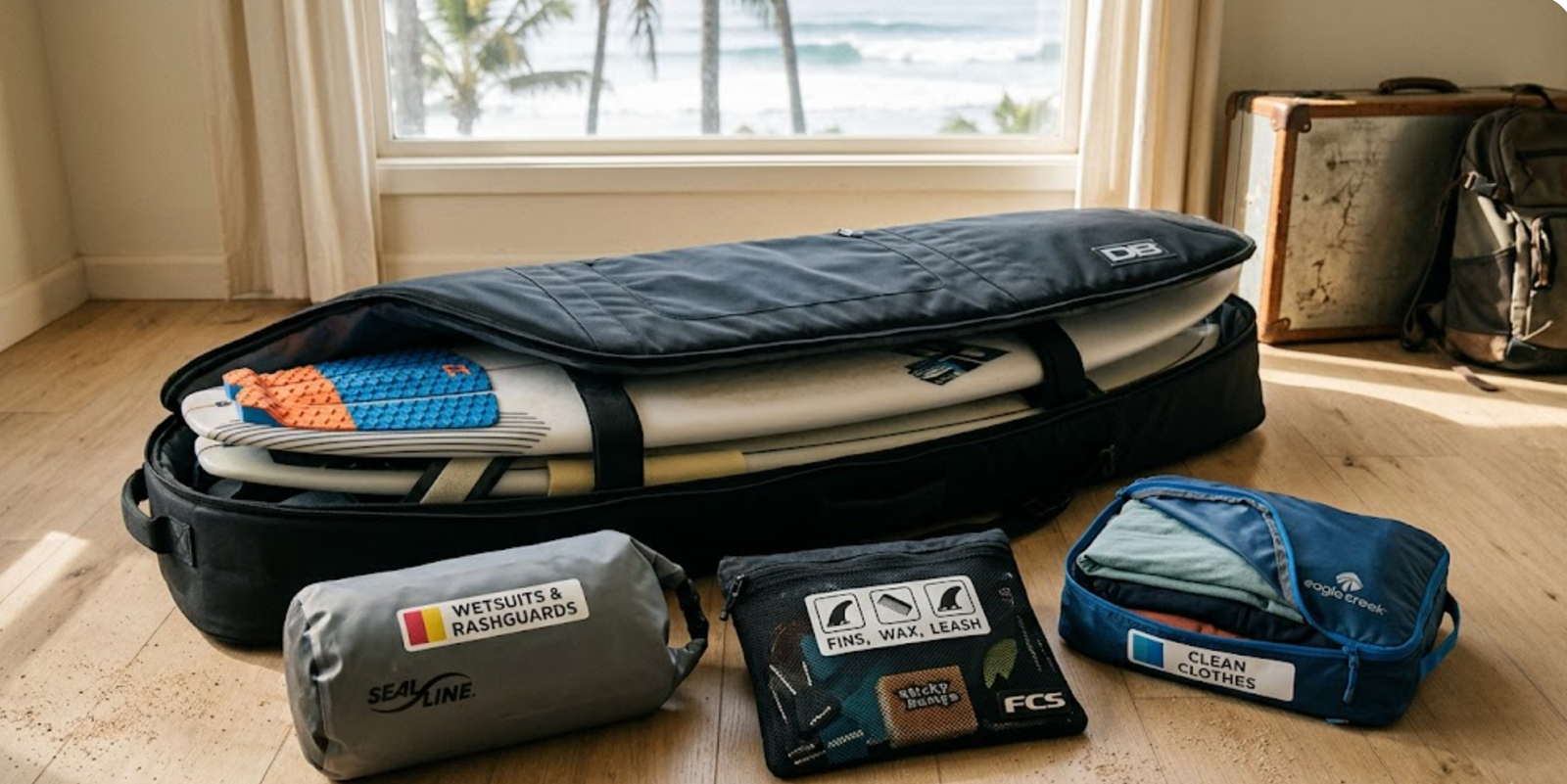
Surf travelers face a specific kind of chaos. Traveling with surfboards, wetsuits, leashes, fins, wax, and sun-faded towels is not the same as packing for a weekend city trip. Surf travel is gear-heavy, moisture-prone, and often rushed — especially when you’re moving between airports, rental cars, boats, and beachside accommodations.
An efficient packing system for surf travel isn’t about cramming more into a bag. It’s about designing a repeatable setup that protects your boards, separates wet from dry, and lets you move quickly without losing small but essential items.
The Big Idea in One Pass
- Protect boards first. Everything else is secondary.
- Separate wet, sandy, and clean gear.
- Make essentials instantly accessible.
- Use a repeatable layout every trip.
- Reduce loose items — consolidate into cubes or pouches.
When your packing system works, airports become logistics, not stress tests.
The Real Challenges of Traveling With Surf Gear
Surf travel introduces three core problems:
1. Fragility.
Boards crack. Fins snap. Rails dent. Airlines are not gentle.
2. Moisture management.
Wetsuits rarely dry fully before departure. Sand shows up everywhere.
3. Constant transitions.
Airport → rental car → hotel → beach → repeat. Every stop requires partial unpacking.
The solution is structural, not reactive.
Choosing the Right Luggage Setup
Your foundation matters more than any accessory.
|
Gear Type |
Ideal Storage Option |
Why It Works |
|
Surfboards |
Absorbs impact and prevents rail damage |
|
|
Wetsuits |
Contains moisture and odor |
|
|
Clothing |
Packing cubes (separate clean/used) |
Speeds unpacking and repacking |
|
Small accessories (fins, wax, leash) |
Hard case or zip organizer |
Prevents small losses and damage |
|
Toiletries |
Avoids contamination of clean clothes |
A dedicated board bag with internal straps keeps boards from shifting. If traveling with multiple boards, use foam rail tape or towels as additional padding between them.
A Repeatable Packing Routine (Step-by-Step)
Consistency saves time. Follow the same sequence every trip:
1. Prep the Boards
- Remove fins.
- Cover rails with foam or travel socks.
- Place boards bottom-to-bottom.
- Fill nose and tail gaps with soft items (rash guards, towels).
2. Isolate the Wet Zone
- Put wetsuits in a waterproof bag.
- Add a small mesh pouch for sandy items.
- Never mix with clean clothing.
3. Build the “First 10 Minutes” Kit
This includes:
- Wax
- Leash
- Fin key
- Sunscreen
- Towel
- Swimsuit
Pack this in an accessible top compartment. When you arrive, you can surf immediately without digging through luggage.
4. Use Clean vs. Worn Cubes
One cube for clean clothing.
One cube for used clothing.
No blending.
5. Final Compression & Check
Shake sand off outer surfaces.
Double-check fin screws.
Zip once. Resist reopening.
Repeat this structure every trip. Over time, it becomes automatic.
Packing Cubes and Waterproof Bags: The Separation Principle
One rule governs surf packing efficiency:
Dry and wet gear must never compete for space.
Packing cubes create micro-compartments. Waterproof bags create moisture barriers. Together, they eliminate cross-contamination.
Use this separation model:
- Clean clothes → standard cube
- Used clothes → breathable cube
- Wetsuit → waterproof roll-top
- Electronics → padded pouch
- Toiletries → sealed kit
If sand spreads, your system fails. If you can open one section without disturbing another, it’s working.
Small Habits That Save Big Stress
- Always pack a lightweight microfiber towel.
- Keep a spare leash in your board bag.
- Bring extra fin screws.
- Store travel documents in the same pocket every time.
- Keep a compact repair kit (ding tape, small resin kit for longer trips).
Efficiency is built on predictability.
Smart Surf Travel Starts With Airline Surfboard Rules
One of the trickiest parts of surf travel is navigating airline rules and fees for your boards. Different carriers treat surfboards and sports equipment in very different ways — from including them in your standard baggage allowance to charging substantial oversize fees. Knowing these policies in advance helps you avoid unexpected charges and last-minute hassles at the airport. A thorough, up-to-date guide to airline surfboard policies and regulations can give you the confidence to plan smarter and travel with less stress.
FAQ: Surf Travel Packing
Q: Should I bring multiple boards?
If the destination has varied conditions and you’re staying more than a week, yes. Otherwise, one versatile board reduces airline fees and stress.
Q: How do I prevent wetsuit odor during travel?
Rinse thoroughly, partially dry, then store in a sealed waterproof bag. Open immediately upon arrival to air out.
Q: Is a hard case better than a padded bag?
For most commercial flights, a high-quality padded board bag with internal straps and rail protection is sufficient. Hard cases are bulkier and harder to transport.
Q: How early should I arrive at the airport with surfboards?
Allow extra time for oversized baggage processing. Surfboards often require manual check-in.
The Outcome of an Organized System
An efficient surf packing system reduces:
- Airport friction
- Gear damage
- Lost accessories
- Transition delays
More importantly, it protects your energy. Surf travel should feel like momentum, not management.
Final Thoughts
Surf travel doesn’t have to be chaotic. With the right luggage, clear separation between wet and dry gear, and a repeatable routine, you can turn packing into a system instead of a scramble.
Top 7 Best Surfboard Wall Racks 2026: Space-Saving and Stylish Solutions
Why Surfing in Morocco is a Bucket List Experience (Top 10 Reasons)

Luke Morris is an avid athlete and the driving force behind Surfhungry, a vibrant online platform dedicated to sharing the joy and passion of surfing and water sports with enthusiasts around the world. With a deep-rooted love for the ocean and a lifelong commitment to riding waves, Luke’s journey as a surfer has inspired him to create a community where like-minded individuals can come together to celebrate their shared passion.