

Although longboard skateboards originated in the mid-1900s, they’ve gone through popularity booms and busts. In recent decades these weirdly proportioned skateboards saw a resurgence but usually face a lot of negative publicity. For those interested in learning more, we’ll delve into everything you need to know about longboard skateboards.
Longboards are a type of skateboard designed for moving at higher speeds than regular skateboards and over greater distances, thanks to their larger wheels and bodies. Good rider balance is essential, and turning is usually slower. Riders also perform different tricks on these skateboards.
Longboard skateboards are among the most contentious topics, depending on which road user you ask. But what is all the hype around longboard skateboards? Are they fantastic? Are they more user-friendly than regular skateboards? What tricks can you do on them? And how alike are they to longboard surfboards?
Table of Contents
What Is A Longboard Skateboard?
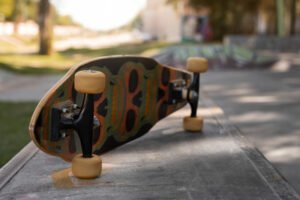
A longboard skateboard is a wooden-bodied board mounted onto metal trucks with bearings on the ends. Wheels mount onto these bearings, which allows the skateboarder (rider) to push themselves along the ground. They are designed for “sidewalk surfing.”
Longboards come in various shapes and sizes, which alter the speed and handling of these boards.
Although the original designs in the 1950s allowed riders to cruise along sidewalks, skateboarders use modern boards for several different purposes, including:
- Carving
- Cruising
- Dancing
- Downhill
- Freestyle
- Slalom
- Street luge
Longboard Skateboards Vs. Regular Skateboards
A longboard skateboard resembles a regular skateboard in that both are (relatively) flat boards mounted on two wheels. However, there are several physical and purpose-related differences.
The table below explores some differences and similarities between the two skateboard types.
| Characteristic | Longboard skateboard | Regular skateboard |
| Length | 35 to 60 in | 28 to 32 in |
| Width | 9 to 10 in | 6.5 to 8 in |
| Wheels | 2.56 to 2.76+ in (diameter)
75 to 85a (hardness) |
1.93 to 2.36 in (diameter)
96 to 101+a (hardness) |
| Method of propulsion | Pushing with a foot
Downhills |
Pushing with a foot
Ramps |
| Areas of use | Roads and sidewalks | Roads and sidewalks
Skateparks |
| Purpose | Faster speeds. Longer rides. Cruising and transportation. | More agile. Trick performing. |
| Origin | 1950s California, but the 1990s saw a popularity explosion. | 1950s California |
Longboards resemble surfboards, while regular skateboards usually have ended that curve upward, facilitating ollies (jumps) and similar tricks.
A regular skateboard’s trucks are also harder/more rigid, improving the board’s responsiveness to kicks and flips while allowing grinds.
Is Longboard Skateboarding Similar To Longboard Surfing?
Unsurprisingly, surfing and skateboarding emulate each other when considering their origins.
The intention behind longboard skateboards was for surfers to bring surfing to the terrestrial environment (surfers in the 1950s wanted to surf on days when conditions weren’t favorable).
While both require exceptional balance and subtle weight shifting, you control longboard surfboards through different movements (front foot in skateboarding, back foot in surfing).
However, both involve using a board in/on the chosen medium and heel/toe movements to make gradual turns (and less gradual turns).
Aside from the size restrictions on a longboard, the styles have many similarities. Both use a carving technique (small turns to reposition) and a skidding/sliding motion to quickly change directions.
The good news is, if you’ve practiced one, it should be a quicker learning curve to bring your balance and handling skills to the other type of board.

Is It Easy To Skate On A Longboard Skateboard?
Although they require balance and a lot of practice, longboards are easier for beginners to ride than regular skateboards.
The advantages that longboard skateboards provide beginners include:
- Longer and wider boards provide more stability.
- Larger and softer wheels improve movement, which means coasting is easier.
- Bigger trucks provide better clearance and accommodate larger wheels.
- A longboard design allows riders to rock side to side or back and forth to build up speed (so you don’t need to put your foot down once you’re going).
Tips For Learning To Skate On A Longboard
Like any new venture, longboard skateboarding is a skill you’ll need to develop through practice and perseverance.
- Master your stance. Balancing on a longboard is a product of standing correctly. First, decide if you’re a “regular” (right foot at the back) or a “goofy” (left foot at the back) rider.
Once you’re on, move your feet shoulder width apart (depending on the board’s length, your feet should be close to or on the bolts that hold the trucks to the board).
Stand with your back foot across the width of your board (perpendicular) and your front foot with the toes pointing slightly forward.
- Practice balancing while stationary. Before you cruise down a steep hill, you’ll need to practice balancing on your board while it’s still. Remember to bend your knees slightly, as this improves balance.
- Practice leaning while stationary. You’ll need to lean your weight onto your toes or heels to turn, so getting a feel for that while balancing is essential (while stationary).
Likewise, it’s wise to practice swiveling on your front toes (so they point toward the front of the board), then turn your body to face forward and practice putting your foot on the ground to “push” or brake. Then turn back to the starting position.
- Once you’re comfortable with the stationary stuff, you can start with slow movements. Practice the same movements and (especially) braking at lower speeds to prevent injuries later.
- After some time, you’ll progress to steeper hills where you can practice turning and braking while balancing.
- If you need a more “stable” board that doesn’t turn too easily, try tightening the kingpin (nut). If you want a board that turns easier, then loosen the kingpin.
- An important skill to learn is carving because you can’t put your foot down to brake at high speeds.
The correct board is essential to learning and improving your techniques.
Choosing The Right Longboard Skateboard
Several types of longboards are designed with a specific purpose in mind. When choosing which longboard to get, you must consider why you want the board.
The different longboard skateboard styles include:
- Carving longboards – these boards are ideal for sharper turns thanks to their slightly shorter wheelbase and cut-out sections close to the wheels (which prevent the wheels from rubbing on the board). Drop-through, pintail, and top-mount boards are excellent for carving.
- Cruiser longboards – most commonly found. These boards are ideal for transportation and make good beginner boards. They often have rounded tails and pointed noses. Pintail longboards are also great for cruising. They have a pointed nose and tail with a wide middle.
Another type of cruising board is the kicktail longboard. These boards have a lip on the rear edge, allowing riders to perform more tricks, like ollies or kickflips. These boards are often shorter than other longboards.
- Downhill longboards – drop-down and drop deck longboards are ideal for downhill skateboarding thanks to their lower profile design (the trucks mount through the board). Stability is essential for the high speed’s skaters reach going down steep hills.
- Freestyle/freeride longboards – These boards travel at higher speeds and are usually drop-down. However, freeride skateboards usually perform ticks and slides while riding.
What To Consider When Choosing A Longboard
Aside from the purpose the skateboard needs to serve, there are several other important factors you’ll need to consider, including:
- Size – larger riders (teenagers and adults) need larger boards. Longer boards (and those with wider wheelbases) are more difficult to turn but better manage higher speeds.
- The shape – there are two major shapes, Directional and Twin/Symmetrical. All other shapes are based on these. Directional boards are better suited to travel in one direction. Pintails, carving, cruising, and downhill board usually fall into this category.
Twin boards (like freeride/freestyle) are identical on both ends, so if you turn 180°, the board works the same.
- Board flex – soft boards absorb shocks better and are ideal for cruising and carving at lower speeds (high speed causes instability). Medium boards are good for cruising and transportation and are slightly more stable at higher speeds. Stiff boards are the best for high speeds.
- Trucks – the trucks are pivotal in how a longboard handles. Trucks consist of a base plate, hangers, and bushings. Different board styles accommodate different trucks, so matching a truck to your board’s purpose is essential.
- Wheels – without wheels, your longboard would be a plank. The wheel type influences how well you corner, how fast you go, and how well you stay connected to the ground.
Maintaining Your Longboard Skateboard
Unfortunately, longboard skateboards, like all machinery and equipment, experience wear-and-tear. While most of the time, the damages go unnoticed, after enough time, the board’s parts wear out. Failure to maintain your board could lead to it breaking or, worse, you being injured.
Proper longboard skateboard maintenance includes:
- Regular cleaning – longboards pick up dirt while in use. Over time this dirt causes problems by blocking bearings, causing slippery surfaces, and damaging the wood.
Putting water onto your skateboard is asking for trouble (wood swells when wet and may cause delamination). Most owners recommend using a sanding belt cleaner to remove dirt and grime.
- Lubricating the bearings – smooth running bearings are essential to a functional skateboard, so you’ll need to ensure they remain lubed up. You need to clean them out, especially if you’ve been in sand/mud, as it mixes with the lubricant and creates a “grind paste.”
When cleaning, remove the plastic caps and use a dedicated cleaning solution. Your bearings need to be 100% dry before you lubricate them.
- General board maintenance includes tightening the various nuts and bolts. If you skateboard with loose fittings, you stand a chance of serious injury.
- Periodically replacing the wheels – the wheels take significant punishment and wear down with us (like sliding).
Although they may not wear through, sometimes one-wheel wears quicker, causing the board to pull sideways. While swapping the wheels is an option, replacing them as a set is better. Cleaning wheels is essential. Soaking them in warm water and soap is adequate.
- Clean your trucks – dirt builds up in the trucks, which leads to an annoying squeak (and other issues). You can fix this by throwing soap shavings into the pivot cup and between the bushings. The squeaking should subside.
Alternatively, a soapy wipe-down of your dismantled trucks also works.
- Replacing the grip tape – grip tape (which covers the top of a longboard) wears down through use. Eventually, you’ll need to replace it.
Longboard Skateboarding Tricks
While longboard skateboards are not geared toward the same tricks as regular skateboards, you can attempt several techniques and maneuvers depending on your skill level.
Basic Longboard Skateboard Tricks
- Kick turns – one of the “basic” turns, a kick turn helps you to turn quicker. You lift the skateboard’s nose slightly by leaning onto your back foot. Then, using your front foot, you direct the longboard skateboard in the direction you want to go (you’re “hopping” the front wheels to turn the board).
- Manuals – similar to how a kick turn works, a manual is when you ride on your back wheels while balancing. Step on the back of the board to lift it and then hold it for as long as possible.
- Carving – Carving is an essential technique for slowing down while longboarding. By leaning from one side to the other, you use up the board’s momentum in turns, slowing yourself down.
Advanced Longboard Skateboard Tricks
- 180° slides – also called a pivot, while traveling forwards, you spin the board around 180° so the back is now the front. While not too difficult, this trick takes some practice.
- Fakie Shovit – like the pivot, your board turns 180°; however, you don’t follow the board. Instead, you kick it around and jump (when the board has moved 90°) so that you continue moving in the original direction while the board makes a 180° turn.
- Stand-up slides – Slides are incredibly valuable when braking. As you move downhill quickly, you’ll lean back and pull the board around in front of you. This movement changes the movement from rolling to skidding on the sides of the wheels.
Conclusion
Since its resurgence in the 90s, longboard skateboarding continued to grow in popularity. Blending elements of regular skateboarding with surfing, longboard skateboarders focus more on speed and extended rides (which the boards lend themselves to) than tricks. However, there are several beginner and advanced-level tricks to choose from when longboarding. The only way to enhance your skills is to get on your board and practice.

Luke Morris is an avid athlete and the driving force behind Surfhungry, a vibrant online platform dedicated to sharing the joy and passion of surfing and water sports with enthusiasts around the world. With a deep-rooted love for the ocean and a lifelong commitment to riding waves, Luke’s journey as a surfer has inspired him to create a community where like-minded individuals can come together to celebrate their shared passion.