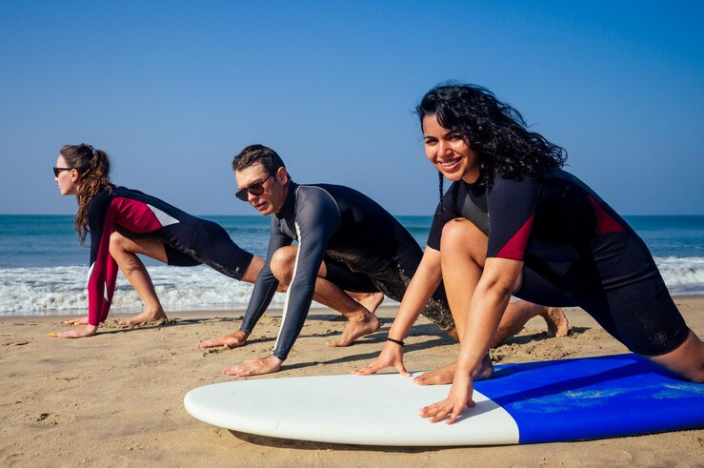
Surfing Mobility Exercises: Surf Performance

Surfing is an addictive sport that is healthy for the body and mind. But the activity comes with a large portion of physical and mental demands, along with a side order of risk. It uses the entire body and requires focus. But as holistic as the sport is, it doesn’t provide everything. Hence the need to incorporate surfing mobility exercises to help reach peak performance and minimize risk. Surfing mobility and strength exercises increase mobility in the hips and spine and improve core strength, protecting your back, shoulders, and neck. They boost stability in key joints, such as hips, knees, and ankles. They can also improve flexibility which enhances your agility and power. Surfing, like gymnastics and ballet, requires the body to be strong and flexible but have stability. If the body isn’t flexible enough, strokes are inefficient, the popup is cumbersome, and the dexterity on the board is lacking. Yet, if the back hyperextends and essential joints wobble, balance is lost, injury risk is raised, and performance suffers. This is why surfing alone will not achieve peak performance. Introduction To Surfing Mobility Training Surfing mobility training incorporates off-the-water exercises that improve strength, flexibility, and stability while reducing injury risk. Exercises can be cross-discipline, using exercises found in yoga, Pilates, and the gym, such as squats. However, most are performed on stable surfaces, as studies have shown that doing so on unstable surfaces can have detrimental results. In short: surfers already have enough unstable surface training by virtue of their sport. They must incorporate on-the-ground exercises and stretches to create a more holistic regime. Benefits Of Surf Mobility Exercises For Surfers The benefit of surf mobility exercises for surfers is better performance while reducing injury risk. For instance, rotation of the shoulders, trunk, and hips is essential for creating powerful, dynamic turns that are fun and wow the crowds. But these maneuvers are not just a matter of power and suppleness. Flexibility combined with power that lacks control can lead to hyperextension injuries in addition to lacking the agility and grace surfers crave. In addition, the body must be able to cushion itself from the forces exerted against it, and there are many thanks to the variables of the sea and the sport. So again, surf mobility exercises enhance a surfer’s performance on the water while making them less likely to be injured. In the end, the better we take care of ourselves, the longer we can enjoy the sport. Top Surfing Mobility Exercises To improve Surf Performance Ready to get started in your new on-the-ground training regime? Here are some top surfing mobility exercises to improve your surf performance. Hip Mobility Exercises Hip strength and mobility are crucial to surfing. They and the pelvis connect the upper body with the lower. If hips are stiff and weak, they impact surfing performance and cause injuries to the back and lower extremity joints, especially in the knees. Many people who think they have bad knees actually have tight hips. However, too many surfers leap into dynamic stretches without establishing the fundamentals. So before you get fancy, start with some basics. 90/90 Hip Stretch The 90/90 hip stretch is the foundation for many advanced surfing mobility exercises for the hips. Sit down on the floor. Extend your right leg in front. Bring your right foot towards your left hip until you have achieved a 90-degree angle. Your knee and outer thigh should remain on the floor and be extended forward. The calf and ankle should align with the bent knee, parallel to your pelvis. Extend your left leg out, in line with the hip. Keeping your thigh straight out from the hip, bend the knee so your left calf and foot point straight back. Both legs should now be at 90-degree angles, making L shapes. Keep your torso upright. Keep your shoulders and pelvis squared. Breathe into the stretch. After holding for 20-60 seconds, change the legs, with left in front and right in the back. Hold again. Watch this Youtube video for how to do the basic 90/90 and begin to increase it into a more intense stretch. Curtsy Lunge Front, back, and side lunges are taught in PE classes around the United States and are excellent for exercising the hips. But the curtsy lunge is only starting to gain the recognition it deserves and should be part of every surfer’s mobility exercise regime. Begin standing, feet shoulder-width apart Step your right foot back like you’re going to curtsy. Thus, your right foot is left of your left foot. Now bend the knee (and pretend you’re in The Game of Thrones). Return feet to side by side. You can now alternate or do all the reps on one side first before switching. As you improve, feel free to add some weight. Do better with visuals? Here’s a YouTube demonstration. Shoulder Mobility Exercises Surfing makes high demands on the shoulders, from paddling out to the all-essential popup. The joint must be strong and supple yet have rock-solid stability, or injury will occur. Here are two stretching and posture exercises to incorporate into your routine. The Sleeper Stretch The sleeper stretch focuses on improving range and rotation by concentrating on the teres minor and infraspinatus muscles. The stretch technically needs no equipment, but you will find it more comfortable with a pillow under your head. Lie on your right side. Bring the right elbow out, in line with your shoulder Bright your right hand up so the arm is now making an L. Take your left arm and press the right hand toward the ground Hold where you meet resistance for 30 seconds Release, bring the L back up, and repeat When finished, repeat the exercise on your left side Need a visual? Here is a YouTube demonstration of the sleeper stretch. Standing Wall Angel And Advanced Variation The standing wall angel is excellent for posture and scapular control. Find a nice, flat wall you can lean … Read more